
Blogs
YouTube SEO: How to Rank Your Videos
Author : Logicloop admin
Publish Date : 2026-09-10
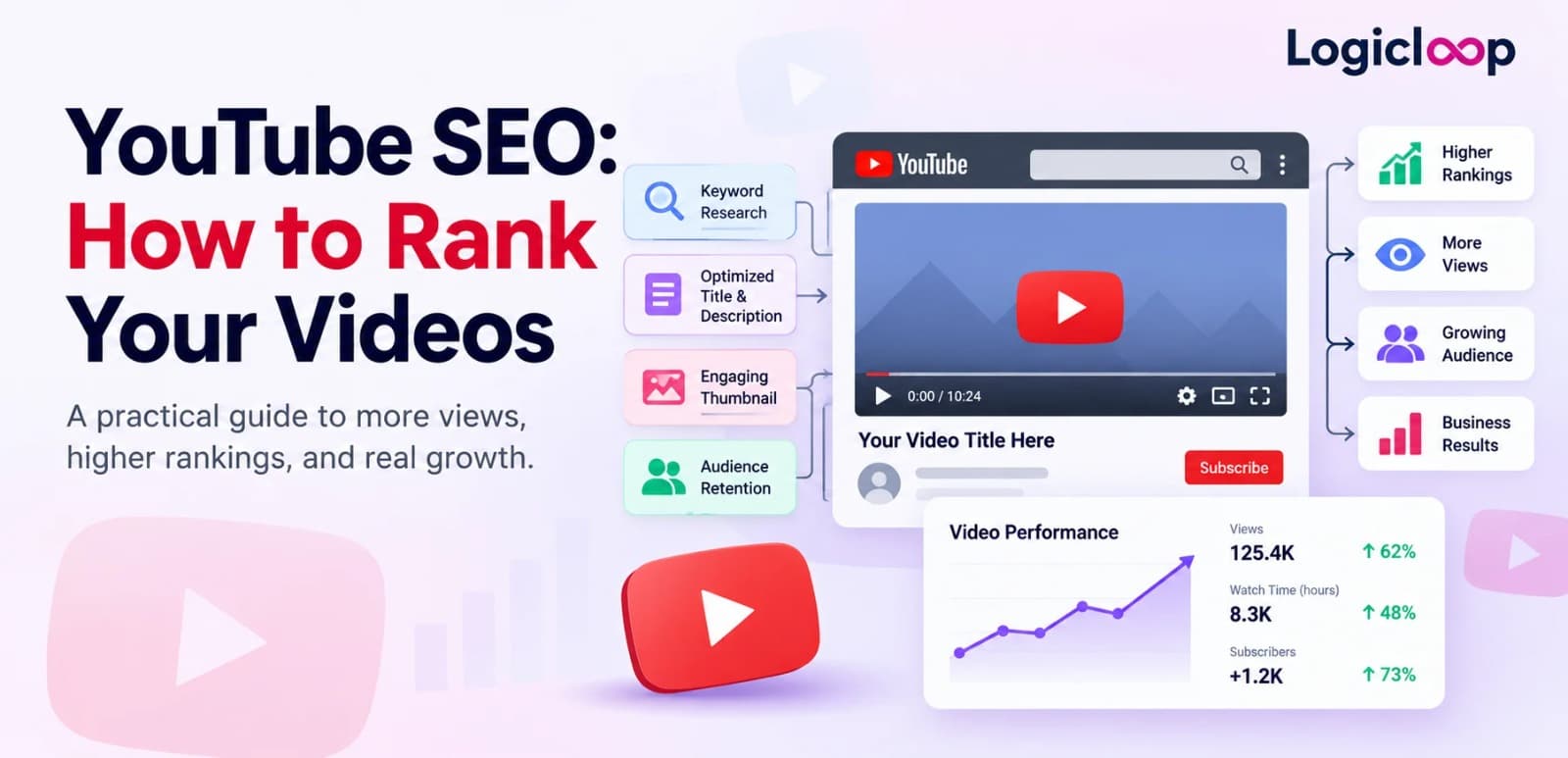
A practical guide to improving YouTube visibility, clicks, retention, and audience growth
A YouTube video can be excellent and still get almost no traffic.
Many creators spend hours recording, editing, and producing videos but give very little attention to discoverability. They publish a video with a generic title, a weak thumbnail, and an unclear description, then expect YouTube to find the right audience.
That approach rarely produces consistent results.
YouTube SEO is not simply about adding keywords to your title or description. YouTube needs to understand what your video is about, while viewers need a strong reason to click, watch, and continue watching.
A successful YouTube SEO strategy combines keyword research, search intent, content quality, titles, thumbnails, audience retention, engagement, and performance analysis.
The objective is not simply to get more views. It is: “Can this video attract the right viewers, satisfy their intent, and encourage them to take the next action?”
Key Takeaways
- Start keyword and topic research before producing the video.
- Understand the search intent behind the target topic.
- Create titles that are specific, clear, and compelling.
- Use thumbnails to support the title and attract attention.
- Deliver the promised value quickly, especially in the opening.
- Use keywords naturally across relevant video elements.
- Focus on audience retention and viewer satisfaction, not views alone.
- Connect related videos through playlists, end screens, and internal references.
- Use YouTube Analytics to identify performance problems.
- Improve existing videos instead of always creating new ones.
- Build topic clusters around subjects that are relevant to your audience.
- Create content based on both audience demand and business value.
What Is YouTube SEO?
YouTube SEO is the process of optimizing videos so they have a better opportunity to appear in YouTube search results and reach relevant viewers through YouTube's recommendation systems.
Unlike traditional search engines, YouTube is both a search engine and a recommendation platform.
A viewer may discover your video by:
- Searching for a specific keyword
- Browsing the YouTube homepage
- Watching a Suggested Video
- Finding your video through a playlist
- Watching a Short
- Clicking a link from another website or social platform
This means YouTube SEO has two important objectives.
Search visibility: Help YouTube understand the topic and relevance of the video.
Viewer performance: Give people a strong reason to click, watch, and continue engaging with the content.
A video can have good keyword optimization but still perform poorly if the title and thumbnail do not generate clicks. Similarly, a video can attract clicks but struggle if viewers leave quickly because the content does not match the promise.
How YouTube Search Actually Works
Think of YouTube as a combination of search and recommendation.
When someone searches “How to do technical SEO,” YouTube needs to determine which videos are relevant to the query. But YouTube can also recommend that same video to viewers who have previously watched content about SEO, websites, digital marketing, or related topics.
This creates two different optimization requirements.
| Discovery Type | What Matters |
|---|---|
| YouTube Search | Topic relevance, search intent, title, description, content |
| Browse | Topic appeal, title, thumbnail, viewer response |
| Suggested Videos | Relevance, viewer behavior, related content |
| Playlists | Topic organization and viewing journey |
| External Traffic | Relevance and viewer experience |
A strong YouTube strategy considers all of these discovery opportunities instead of focusing only on keyword rankings.
Start With Search Intent
Before choosing a keyword, understand what the viewer actually wants.
Consider these three searches:
- “SEO”
- “How to do SEO for a small business”
- “SEO audit checklist for beginners”
These searches have very different levels of intent.
“SEO” is broad and could mean almost anything. “How to do SEO for a small business” indicates that the viewer wants practical information. “SEO audit checklist for beginners” suggests that the viewer is looking for a specific process or resource.
Your video should match that expectation.
If someone searches for an SEO tutorial and your video spends the first five minutes discussing the history of search engines, the viewer may leave before reaching the useful information.
Before producing a video, ask:
- What problem is the viewer trying to solve?
- What information are they expecting?
- What type of video would answer the query best?
- Is the viewer looking for education, comparison, or a solution?
- Can the video deliver the expected value quickly?
The stronger the match between search intent and content, the more useful the video becomes.
Find Topics With Search Demand
Keyword research should happen before video production.
You can use several sources to identify potential topics:
- YouTube autocomplete
- Google Keyword Planner
- Google Trends
- YouTube search suggestions
- Competitor research
- Existing YouTube Analytics
- Related questions
- Industry trends
Do not automatically target the keyword with the highest search volume. A smaller keyword with stronger intent may attract a more relevant audience.
For example:
Broad topic: “Digital Marketing”
More specific topic: “Digital Marketing Strategy for Real Estate”
The first keyword may have a larger potential audience, but the second can attract viewers who are specifically interested in marketing real estate businesses.
For business channels, relevant attention is often more valuable than maximum views.
Research Your Competitors
Before creating a video, search for the topic on YouTube and analyze the videos already performing well.
Competitor research helps you understand what viewers are already watching and where content gaps exist.
- Video titles
- Thumbnails
- Video length
- Content structure
- Topics covered
- Questions answered
- Comments
- Viewer feedback
- Engagement
- Content gaps
Do not copy competitor videos. Instead, identify what they are doing well and determine how your video can provide something more useful.
For example, if competing videos explain a concept but do not provide practical examples, you could create a video with step-by-step instructions, screenshots, real examples, templates, or case studies.
The goal is to create a better viewer experience, not simply another version of the same video.
Write Titles That Earn the Click
A YouTube title has two important jobs. It needs to communicate the topic clearly and give viewers a reason to click.
Consider these examples.
Weak: “SEO Tips”
Better: “7 SEO Tips That Can Improve Your Google Rankings”
Stronger: “7 SEO Fixes I'd Make Before Publishing Another Blog”
The stronger version introduces a specific problem and promises practical information.
A good YouTube title should:
- Clearly communicate the topic.
- Use the primary topic naturally.
- Make the benefit understandable.
- Create curiosity without misleading the viewer.
- Match the actual content.
- Be specific enough to differentiate the video.
Avoid clickbait. A high CTR does not help much if viewers immediately leave because the video does not deliver what the title promised.
Thumbnails Are Part of YouTube SEO Performance
Your title and thumbnail should work together.
Do not simply repeat the same sentence in both.
For example:
Title: “Why Your Website Traffic Isn't Converting”
Thumbnail: “TRAFFIC ≠ SALES”
The title explains the subject while the thumbnail creates a visual reason to stop scrolling.
A strong thumbnail should be:
- Simple
- Easy to understand
- Visually clear
- Relevant to the topic
- Readable on smaller screens
- Different enough from competing videos
Avoid adding too much text. The viewer should understand the main idea of the thumbnail within a second or two.
The First 30 Seconds Matter
One of the easiest ways to lose viewers is to waste the opening.
Avoid starting every video with long introductions such as “Hi guys, welcome back to another video” or “Before we start, don't forget to subscribe.”
Instead, introduce the problem and promise immediately.
Example: “If your website gets traffic but almost nobody submits an enquiry, increasing traffic may not be your first problem. In this video, I'll show you five things I'd check before spending more money on SEO.”
This opening tells the viewer:
- What problem is being discussed.
- Why the problem matters.
- What they will learn.
- Why they should continue watching.
The opening should confirm that the viewer made the right decision by clicking.
Use Keywords Naturally
Keywords can help YouTube understand the topic of your video, but keyword stuffing should be avoided.
Use the primary topic naturally in relevant areas such as:
- Video title
- Description
- Spoken content
- Chapters
- Relevant tags
- Supporting text where appropriate
Your description should primarily help viewers understand the video.
Avoid descriptions that look like a list of repeated keywords. Instead, write a natural summary that explains what the video covers, who it is for, what viewers will learn, important sections, and relevant next steps.
Structure Long-Form Videos for Retention
Longer videos are not automatically better.
A focused 12-minute video that solves a problem can be more useful than a 25-minute video filled with unnecessary information.
A simple structure is:
- Hook
- Problem or context
- Main content
- Examples or demonstrations
- Summary
- Next action
Every section should move the viewer closer to the promised outcome. Remove unnecessary explanations if they do not contribute to the viewer's goal.
The objective is not to make the video longer. It is to make every minute useful.
Use Chapters to Improve Usability
Chapters are especially useful for longer educational and tutorial videos.
Example:
00:00 Introduction
01:12 Keyword Research
03:45 Title Optimization
06:10 Thumbnail Strategy
08:30 Audience Retention
10:15 YouTube Analytics
Chapters make it easier for viewers to navigate the video and find specific sections.
They are particularly useful for:
- Tutorials
- How-to videos
- Product demonstrations
- Educational content
- Interviews
- Long-form guides
Use descriptive chapter names rather than generic labels such as “Part 1” or “Section 2.”
Build Topic Clusters on YouTube
Publishing unrelated videos every week can make your channel difficult to structure.
Instead, build topic clusters.
For an SEO-focused channel, one cluster could look like:
SEO Basics → What Is SEO? → How Google Search Works → Keyword Research → On-Page SEO → Technical SEO
These videos can support one another through:
- Playlists
- End screens
- Video descriptions
- Pinned comments
- Verbal references
- Related videos
This gives viewers a reason to continue watching your content.
A strong YouTube channel should not feel like a collection of random videos. It should feel like a library of connected information.
Measure the Right YouTube SEO Metrics
Views are useful, but views alone cannot tell you whether a video is successful.
- Impressions
- Click-through rate (CTR)
- Average view duration
- Audience retention
- Traffic sources
- Subscribers gained
- Engagement
- Returning viewers
Different metrics help identify different problems.
| Performance Pattern | Possible Problem |
|---|---|
| High impressions + low CTR | Title or thumbnail problem |
| High CTR + poor retention | Content or expectation problem |
| Low impressions + strong retention | Topic or discovery problem |
| High views + low relevant traffic | Audience targeting problem |
| Strong retention + strong engagement | Potential format to scale |
The objective is to diagnose why a video is performing the way it is.
Optimize Existing YouTube Videos
You do not always need to create a new video to improve your channel.
Existing videos can sometimes be improved by analyzing their performance and changing specific elements.
High Impressions + Low CTR
The video is receiving visibility, but viewers are not clicking.
Review:
- Title
- Thumbnail
- Topic positioning
- Value proposition
Consider testing a clearer title or a stronger thumbnail concept.
High CTR + Poor Retention
People are clicking but leaving early. This can indicate that the video is not meeting the expectation created by the title and thumbnail.
Review:
- First 30 seconds
- Introduction length
- Content structure
- Pacing
- Relevance
- Delivery of the promised information
Low Impressions + Strong Retention
People who find the video may like it, but YouTube is not generating enough exposure.
Review:
- Search demand
- Topic selection
- Keyword targeting
- Competition
- Title
- Thumbnail
This approach is more effective than simply creating more videos without understanding the problem.
Use YouTube Analytics to Improve Future Content
YouTube Analytics should influence your future content strategy.
Suppose several videos about technical SEO consistently generate strong retention and relevant traffic. That is a signal that your audience may be interested in more technical SEO content.
Look for patterns such as:
- Which topics attract relevant viewers?
- Which videos generate stronger retention?
- Which videos generate subscribers?
- Which topics generate more shares or engagement?
- Where do viewers commonly leave?
- Which traffic sources perform best?
- Which topics receive impressions but few clicks?
Use these insights to improve your next batch of videos.
Use Trends Without Becoming a Copycat
Trending topics, formats, and audio can help increase content discovery. But trends should support your strategy, not replace it.
For example, a general trend might be:
“Things I wish I knew before starting SEO.”
A digital marketing agency could adapt that format into:
“Things I wish every business knew before hiring an SEO agency.”
The trend provides the format. Your expertise provides the value.
The best approach is to adapt trends to your audience rather than copying another creator's content.
How Often Should You Post YouTube Videos?
There is no single publishing frequency that guarantees YouTube growth.
Consistency is useful because it gives your channel a predictable content pipeline and provides more opportunities to learn from performance data.
However, publishing more videos does not automatically mean better results.
| Frequency | Content Focus |
|---|---|
| 1 video/week | High-quality educational content |
| 2 videos/week | Educational + practical content |
| 3 videos/week | Educational + problem-solving + case study |
Choose a frequency your team can maintain consistently.
After publishing for several weeks, review the data and identify which topics, hooks, thumbnails, videos, and formats generate the strongest results. Then scale what works.
A Simple YouTube SEO Workflow
Use the same process for each video.
Step 1: Choose One Audience Problem
Do not try to solve multiple unrelated problems in one video. Choose one specific problem your target viewer understands.
Step 2: Research the Topic
Check YouTube suggestions, competitor videos, Google Trends, keyword tools, and existing analytics.
Step 3: Understand Search Intent
Determine what the viewer actually wants to learn or accomplish.
Step 4: Create the Video Structure
Plan the hook, main points, examples, conclusion, and next action before recording.
Step 5: Write the Title
Create a specific title that communicates the topic and benefit.
Step 6: Create the Thumbnail
Make the thumbnail complement the title rather than repeating it.
Step 7: Optimize the Video
Add the relevant title, description, chapters, tags, and related content.
Step 8: Publish and Measure
Review impressions, CTR, retention, traffic sources, and subscriber activity.
Step 9: Improve
Use the data to determine what should change in your next video.
Common YouTube SEO Mistakes
Targeting Keywords Without Understanding Intent
A keyword can have high search demand but still be unsuitable for your content. Always understand what the viewer expects.
Using Broad Titles
Titles such as “SEO Tips” or “Marketing Strategy” do not communicate enough value or differentiation.
Using Clickbait
Clickbait may increase initial clicks but can damage viewer satisfaction if the content does not deliver the promised information.
Focusing More on Production Than Topic Selection
A highly edited video can still fail if the topic does not have sufficient audience demand or relevance.
Writing Descriptions Only for Search Engines
Descriptions should help viewers understand the video rather than becoming a list of repeated keywords.
Ignoring Thumbnails
A strong video still needs effective packaging to compete for attention.
Making Videos Unnecessarily Long
Do not extend a video simply to increase its duration. Focus on delivering the required information efficiently.
Never Updating Old Videos
Existing videos may have opportunities for improved titles, thumbnails, descriptions, structure, or related content.
Publishing Without Reviewing Analytics
Without performance analysis, it becomes difficult to understand what your audience actually wants.
YouTube SEO Checklist
Topic & Keyword Research
- Is there clear demand for the topic?
- Have you checked YouTube suggestions?
- Is the topic relevant to your target audience?
- Have you reviewed competing videos?
- Does the topic have clear search intent?
Video Content
- Does the video answer the intended question?
- Is the opening strong?
- Does the video deliver the title's promise?
- Is unnecessary information removed?
- Are examples or demonstrations included where useful?
Title & Thumbnail
- Is the title specific?
- Is the main topic clear?
- Does the title create interest?
- Does the thumbnail complement the title?
- Is the thumbnail easy to understand on mobile?
Optimization
- Is the primary topic used naturally?
- Is the description useful?
- Are chapters included where appropriate?
- Are relevant tags used?
- Are related videos connected?
Performance
- Are impressions increasing?
- Is the CTR improving?
- Are viewers staying engaged?
- Where are viewers dropping off?
- Which traffic sources are generating relevant viewers?
- Are viewers subscribing or watching additional videos?
YouTube SEO Decision Framework
Before producing a video, evaluate the idea across five areas.
| Factor | Low | High |
|---|---|---|
| Audience relevance | Broad or unclear | Highly specific |
| Search intent | Unclear | Strong and specific |
| Hook strength | Generic | Creates immediate interest |
| Content value | Basic | Useful or distinctive |
| Business relevance | No clear connection | Supports a business objective |
If most factors are low, improve the idea before investing time in production.
If the topic has strong audience relevance, clear intent, a compelling hook, useful information, and a measurable objective, it is a stronger candidate for production.
Where Should You Start?
If you are starting or improving a YouTube channel, do not create 30 unrelated videos.
Start with 10 topics around one relevant subject.
For example, a digital marketing agency could build an SEO content cluster:
SEO Basics
- What Is SEO?
- How Google Rankings Work
- Keyword Research for Beginners
On-Page SEO
- On-Page SEO Checklist
- Title Tag Optimization
- Internal Linking Strategies
Technical SEO
- Technical SEO Basics
- Common Technical SEO Errors
- How to Perform a Technical SEO Audit
Then connect these videos through playlists, descriptions, end screens, and verbal references.
Publish consistently and review performance over several weeks.
The goal is to identify which topics, formats, titles, and hooks repeatedly attract the right audience.
Final Verdict
The best YouTube SEO strategy is not about publishing the maximum number of videos. It is about creating useful videos that attract the right audience, satisfy their intent, and encourage continued engagement.
A strong YouTube strategy follows this process:
Audience → Topic → Search Intent → Content → Title → Thumbnail → Retention → Analytics → Optimization
Start with a specific audience problem. Research the topic and understand the search intent. Create a useful video that delivers the promised value quickly. Package it with a strong title and thumbnail. Then use YouTube Analytics to understand what worked and what needs improvement.
For business channels, the objective should not be maximum views at any cost.
A video with 2,000 highly relevant viewers can be more valuable than a video with 200,000 viewers who have no interest in your product or service.
The ultimate goal of YouTube SEO is to attract the right viewers, provide the right information, build trust, and move those viewers toward the next useful action.