
Blogs
The Marketing Funnel Explained: TOFU, MOFU, BOFU Content
Author : Logicloop admin
Publish Date : 2026-07-28
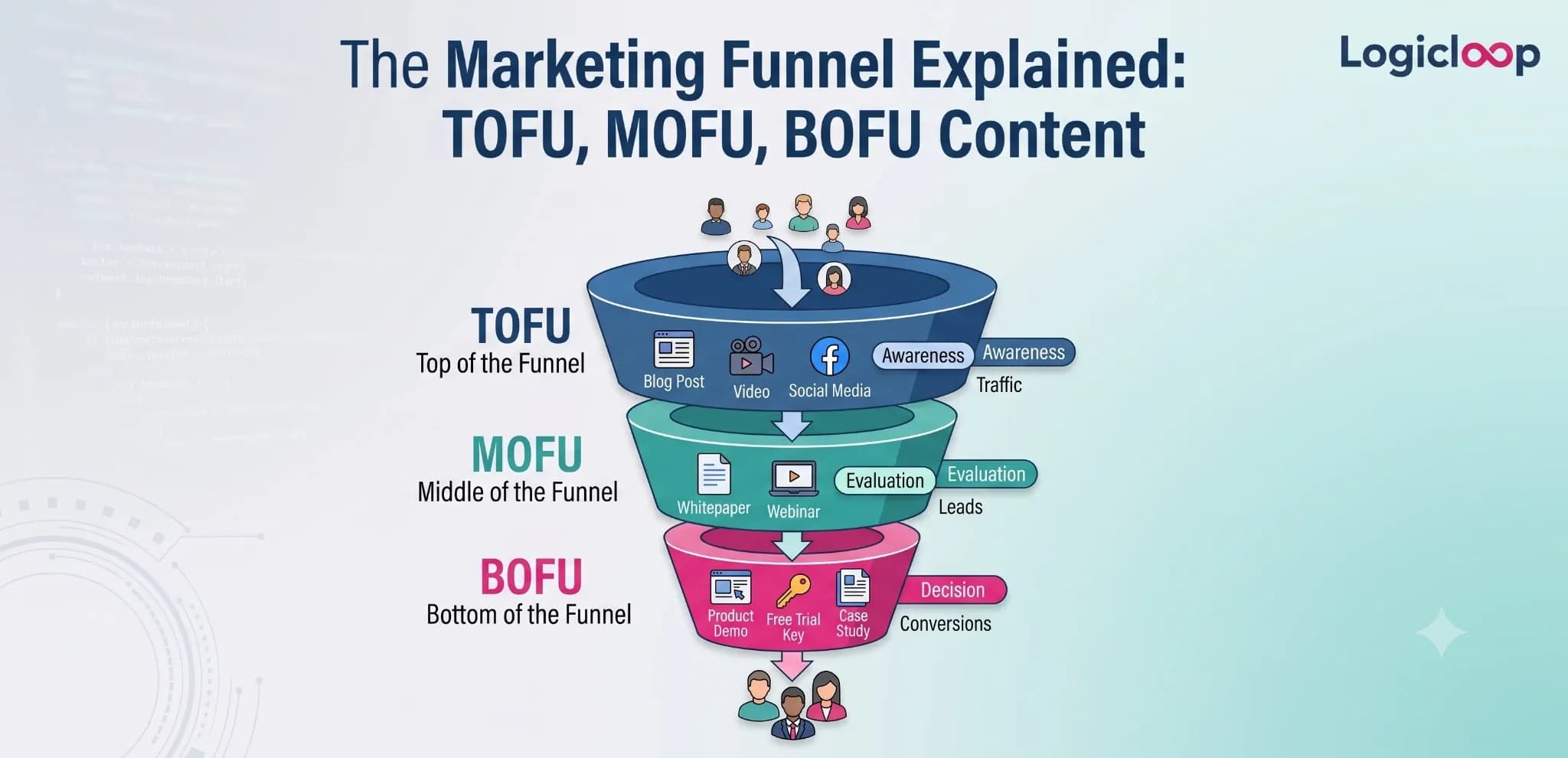
Ask five marketers to describe their content strategy and four of them will reach for the same three letters: TOFU, MOFU, BOFU. The shorthand has gotten so common that people forget it ever needed explaining. And that's exactly the problem. Plenty of folks who toss these terms around couldn't actually tell you why a blog post lives in one bucket while a case study sits in another.
So let's fix that. Not with a glossary, but with the reasoning underneath it, because once the logic clicks, deciding what to publish gets a lot easier.
Here's the short version. The marketing funnel is a picture of how a stranger turns into a customer. It's wide at the top, where crowds of people wander in with only a fuzzy sense that something's wrong. It narrows toward the bottom, where a much smaller group is genuinely ready to pull out a credit card. TOFU means top of funnel, MOFU means middle of funnel, and BOFU means bottom of funnel. Each stage maps to a different level of buyer awareness, and each one demands a different kind of content.
Key Takeaways
- TOFU content builds an audience among people who barely know they have a problem — it earns attention, it doesn't close deals.
- MOFU content nurtures leads who are actively comparing solutions; this is where credibility gets built.
- BOFU content removes friction for buyers who are choosing between you and two named competitors.
- Most teams over-invest in the top and starve the bottom — only about 14% of marketers report creating BOFU content.
- The funnel is a planning tool, not a literal map of how real people behave. Use it that way.
Why the framework exists in the first place
The whole point of TOFU, MOFU, BOFU is matching what you publish to how ready the reader actually is. Sounds obvious. It isn't, because the failure modes are subtle.
Drop a hard sales pitch in front of someone who just realized they have a problem, and you'll spook them. They're not shopping yet. Meanwhile, serve up a gentle, educational explainer to someone who's already comparing vendors and reaching for their wallet, and you'll bore them right off the page. Same content, wrong stage, wasted effort both times.
That mismatch is what the framework is designed to prevent. Think of it less as a set of rigid categories and more as a question you ask before you write anything: how aware is this person, really?
Top of Funnel: content for people who don't know you exist
TOFU content targets people who've felt a problem but haven't named it, let alone started looking for a fix. They aren't thinking about your product category. They might not know your category exists. So anything that smells like a pitch loses them on sight. Your job here is to be useful and ask for nothing back.
In practice, that looks like blog posts, explainer videos, infographics, short-form social content, and beginner-friendly guides — usually built around the kind of question someone types into a search bar at 11pm.
Say you sell a project management tool. A strong TOFU piece is not "5 Reasons Our Software Beats the Competition." It's more like "Why Your Team's Meetings Keep Running Long (And What to Do About It)" — an article that never once mentions your product and just, well, helps. That's the piece that ranks, gets shared, and quietly earns trust from someone who has no clue yet that a tool like yours is out there.
Be honest about what this traffic does
Most of it doesn't convert right away. A lot of it never converts at all. One estimate pegs the typical conversion rate at this stage around 4.6%, which sounds bleak until you remember TOFU was never built to close anything. It exists to build the audience you'll eventually sell to.
There's a newer wrinkle worth flagging. Research suggests more than half of consumers — roughly 55% — now use AI tools somewhere in their product research, and nearly 60% say AI has swayed a shopping decision. That reshapes how TOFU content has to be written. You're no longer just fighting for a spot in Google's results. You're competing to be the clean, quotable answer an AI assistant decides to surface.
The trap at this stage
Here's the twist: the most common mistake isn't publishing bad TOFU content. It's publishing too little of everything else, because top-of-funnel work is easy to justify and comfortable to keep making.
One analysis found roughly half of marketers concentrate their content efforts right here at the top. That makes a certain sense — most of the funnel's total volume passes through this stage. But the danger isn't neglecting TOFU. It's treating TOFU as the entire strategy and never building anything for the audience it works so hard to attract.
Middle of Funnel: now they know they have a problem
By the time someone lands in MOFU, they've stopped Googling vague symptoms and started researching real solutions. They know they need a project management tool, or a new accounting process, or a marketing agency. They just haven't picked one yet — or even settled on which type fits.
This is where lead nurturing earns its keep. Nurturing is the ongoing work of staying in front of a prospect with helpful, relevant content over time, rather than trying to slam-dunk the sale on the first touch.
MOFU content runs longer and more specific than TOFU: comparison guides, in-depth case studies, webinars, interactive tools like calculators or assessments, and email sequences that walk a subscriber through a problem step by step. It's also where gated content shows up most — material parked behind a form, so a visitor trades their email (and sometimes more) to get in. Ebooks, template packs, benchmark reports: all classic gated assets. The trade is fair as long as what's behind the form is genuinely worth the contact info.
A comparison that actually earns trust
Take a guide like "Asana vs. Trello vs. [Your Tool]: Which One Actually Fits a 10-Person Team?" Done honestly, it doesn't crown your product king of every category. It admits where a competitor wins for certain teams.
Counterintuitive as that feels, the honesty is what turns a reader into an MQL — a marketing qualified lead, meaning someone who's engaged enough with your content that sales can reasonably reach out. People can smell a rigged comparison from a mile off, and the moment they do, your credibility evaporates.
The payoff for getting MOFU right
The numbers here are hard to ignore. Effective middle-of-funnel strategies have produced conversion rates as high as 75%, and email stays one of the strongest channels at this stage — around 72% of email use cases here report success.
Nurtured leads also tend to be worth more. One figure suggests a research-led nurturing approach can generate 50% more sales-ready leads, with nearly half of those going on to convert. That's why MOFU gets described as the stage where deals are quietly won or lost, long before anyone ever hops on a call with sales.
TOFU vs. MOFU vs. BOFU at a glance
| Dimension | TOFU (Top) | MOFU (Middle) | BOFU (Bottom) |
|---|---|---|---|
| Buyer mindset | "Something's off" | "I need a solution" | "Which vendor do I pick?" |
| Goal | Attract & educate | Nurture & qualify | Convert & close |
| Content types | Blog posts, videos, infographics, guides | Comparison guides, case studies, webinars, gated ebooks | Demos, free trials, pricing pages, testimonials |
| Lead label | Anonymous visitor | MQL | SQL |
| Reader wants | Help, no strings | Confidence in a choice | Proof it works |
| Typical CTA | Read more / subscribe | Download / register | Book a demo / start trial |
Bottom of Funnel: content that actually closes
BOFU is where a prospect quits comparing categories and starts comparing you — specifically, against two or three named competitors. They know what they want. Now they're deciding who to buy it from. Sales teams often start talking about SQLs here: sales qualified leads, prospects vetted as ready for a direct conversation rather than more nurturing.
Content at this stage should strip away friction, not pile on persuasion. Product demos, free trials, detailed case studies with real outcomes, head-to-head comparison pages, pricing breakdowns, testimonials — all of it belongs at the bottom.
The strongest example is usually a case study built around one specific customer. Not "our platform improves efficiency" floating in the abstract, but a walkthrough of a single real client: their starting problem, what they tried, and what changed after they switched. Enough detail that a skeptical reader can picture their own team living through the same story.
Pro Tip: When you write a BOFU case study, lead with the before state, not your product. A reader who recognizes their own mess in your customer's starting point is already half-sold before you introduce the fix.
The imbalance that should bother you
Here's the part that should nag at most marketing teams. Only about 14% of marketers report actually creating BOFU content, versus the roughly 50% camped out at the top of the funnel.
That's a strange gap, because BOFU is where the highest-intent traffic lives and it's the stage tied most directly to revenue. Brands that build across the full funnel — instead of leaning almost entirely on TOFU — have shown meaningfully better returns. One analysis put the difference at roughly 45% higher ROI for full-funnel brands over single-stage competitors.
If your content calendar is stacked with blog posts and thin on comparison pages, case studies, and demo content, that gap is probably the single most expensive thing on it.
Is the funnel even real, though?
Not everyone buys this model, and it's worth taking the pushback seriously instead of pretending TOFU, MOFU, BOFU is settled science. It isn't.
LinkedIn creator Pierre Herubel has argued publicly against the framework, and his critique cuts deeper than the usual "well, it's not perfectly linear" caveat marketers tack on as an afterthought. His take is blunt: "There is no funnel. It's circular, it's systemic, it's uncontrollable, it's unpredictable."
His point is that real buyers don't glide from awareness content to consideration content to decision content in tidy order. They bounce between formats and channels. They'll read a case study before they've ever seen your intro blog post. They get nudged by conversations, reviews, and social posts that map to no stage at all. His fix isn't a better funnel — it's a wide content ecosystem spread across formats and channels, with fast feedback loops, instead of a hand-engineered linear path.
And honestly? There's a lot to that. B2B buying committees now pull in multiple people who each enter the research at a different moment. A single buyer might read a BOFU comparison page on Monday and a TOFU explainer on Tuesday, purely because that's what showed up in the feed.
Stretching the model instead of scrapping it
Even marketers who use tofu mofu bofu every day will admit, if you press them, that it's a planning tool more than a literal map of any one person's behavior.
Some have tried extending it rather than tossing it. Marketing writer Dave Chaffey, for one, has proposed a fourth stage after BOFU — sometimes called RoFu, for retention of funnel — covering the content that keeps a customer engaged and upselling after the sale closes. The reasoning: the three-stage version stops too early and ignores the value sitting in your existing customer base.
The honest takeaway is that the funnel is a simplification, and simplifications stay useful right up until you start believing they're literally true. Treat it as a way to organize what you produce, not a rulebook for how customers think.
How to turn this into an actual strategy
Knowing the three stages doesn't hand you a working content funnel. The teams that squeeze real value out of the model tend to do a handful of things on repeat.
- Audit what you've already published and sort it honestly by stage. This almost always exposes a bloated pile of TOFU and a thin, neglected stack of BOFU.
- Stop treating each piece as a one-off. Link them. A TOFU blog post should point toward a MOFU comparison guide, which points toward a BOFU demo request — a path, not a heap of disconnected pages.
- Design for out-of-order reading. Some people will hit your MOFU comparison page cold from a search engine. Make sure it still makes sense to them, because plenty will arrive that way.
None of this means publishing more. Usually it means publishing differently — with a clearer sense of who each piece is for and what you want them to do next.
A quick self-audit checklist
- Every published asset is tagged by funnel stage (TOFU / MOFU / BOFU)
- You have at least a few genuine BOFU pieces, not just blog posts
- TOFU articles link forward to a relevant MOFU asset
- MOFU assets include a clear next step toward BOFU
- Your comparison pages admit where a competitor wins
- Case studies name a real starting problem, not just a vague outcome
- Someone owns the funnel map beyond a single planning slide
Common mistakes to avoid
Even teams that know the framework cold trip over the same things. A few worth watching for:
- Confusing traffic with progress. Big TOFU numbers feel like winning. They mean nothing if there's no MOFU or BOFU content to catch that audience.
- Gating content that isn't worth it. A thin two-page PDF behind a form annoys people and poisons your lead quality.
- Writing BOFU content that keeps selling. By the time someone reaches a demo page, they're sold on the category. Give them proof and remove friction, don't restate benefits.
- Building the funnel once and walking away. Buyer behavior shifts, especially with AI now shaping early research. A funnel map from two years ago may already be stale.
Frequently Asked Questions
What do TOFU, MOFU, and BOFU actually stand for?
They're shorthand for top of funnel, middle of funnel, and bottom of funnel. Each label marks a different level of buyer awareness — from barely aware of a problem (TOFU) to actively choosing a vendor (BOFU).
How do I know which stage a piece of content belongs to?
Ask what the reader already knows. If they don't yet realize they have a problem, it's TOFU. If they're comparing solutions, it's MOFU. If they're comparing you against named competitors, it's BOFU.
Should every blog post avoid mentioning my product?
Not every one — but your true TOFU pieces should. The moment a top-of-funnel article turns into a pitch, it loses the people it was meant to attract. Save the product talk for MOFU and BOFU.
What's the difference between an MQL and an SQL?
An MQL (marketing qualified lead) has engaged enough with your content that sales can reasonably follow up. An SQL (sales qualified lead) has been vetted as ready for a direct sales conversation. MQLs live around MOFU; SQLs show up at BOFU.
Is gated content still worth it?
Yes, when the material behind the form genuinely earns the email address. Gate a substantial ebook, template pack, or benchmark report — not a flimsy checklist a visitor could've found anywhere.
Why do so few marketers create BOFU content?
Mostly because it's hard to connect a blog post to revenue, so teams keep making the comfortable top-of-funnel stuff. But with only about 14% of marketers producing BOFU content, it's often the easiest place to find growth without buying more traffic.
Does the funnel still apply now that buyers use AI to research?
The stages still hold as a planning tool, but the behavior is messier than ever. With more than half of consumers using AI in their research, buyers jump between stages freely — so write content that stands on its own regardless of where someone enters.
Is the marketing funnel outdated?
It's a simplification, and critics like Pierre Herubel argue real buying is circular and unpredictable rather than linear. That's fair. Use the funnel to organize what you produce, not to predict exactly how any single customer will behave.
What is RoFu?
RoFu — retention of funnel — is a proposed fourth stage after BOFU, covering content that keeps existing customers engaged and drives upsells. Dave Chaffey has championed it on the grounds that the classic three-stage model stops right when a customer becomes valuable.
How much BOFU content should I have?
There's no magic ratio, but if your calendar is almost all blog posts, you're likely under-invested. Full-funnel brands have shown roughly 45% higher ROI than single-stage ones, and BOFU is where the highest-intent traffic sits.
Final Thoughts
The funnel isn't gospel. It's a lens — a way to keep asking whether the thing you're about to publish actually fits how ready your reader is. Lean too hard on any one stage and the whole thing stops working, which is exactly what happens when a content calendar fills up with TOFU and forgets everyone that traffic attracts.
If there's one move worth making after reading all this, it's the least glamorous one: go count how much of your last quarter's content genuinely targeted a bottom-of-funnel reader. For most teams that number lands lower than they'd guess — and it's usually the fastest place to find growth that doesn't hinge on dragging more strangers through the door.
Popular Searches:
Digital Marketing Agency | Brand Strategy Agency | Influencer Marketing Agency | Google Ads Management Agency | Facebook Ads Agency | Instagram Ads Agency | Performance Marketing Agency | Website Development Company | SEO services in Mumbai