
Blogs
SEO Agency vs In-House SEO: Which Delivers Better ROI?
Author : Logicloop admin
Publish Date : 2026-09-10
Professional SEO Content
SEO is rarely a one-person job.
A business can hire an SEO executive, give them access to Google Search Console and an SEO tool, and expect organic traffic to grow. But serious SEO often requires technical expertise, content production, development support, analytics, digital PR, and continuous optimization.
This creates a common business decision:
Should you build an in-house SEO team or hire an SEO agency?
There is no universal winner.
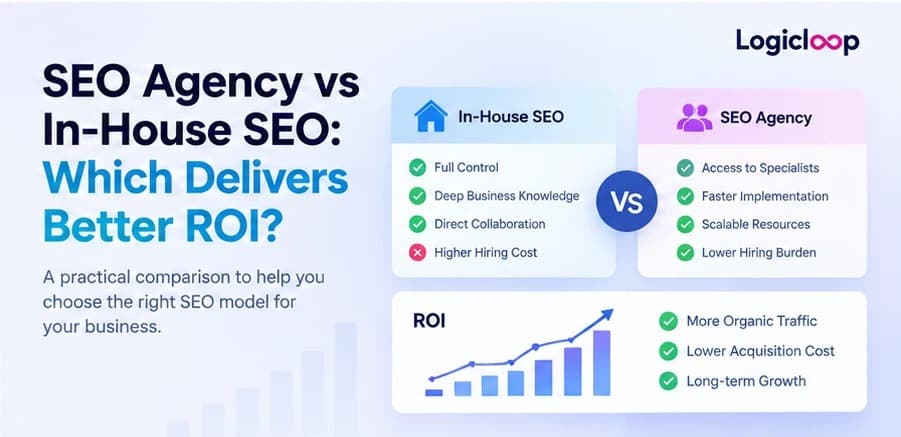
An in-house SEO team can provide deeper business knowledge and greater control. An agency can provide access to multiple specialists without the cost of building the entire team internally.
The better option depends on your business size, SEO goals, available resources, implementation capacity, and expected return.
The right question is not simply:
“Which costs less?”
It is:
“Which model can generate the required SEO results at the lowest sustainable total cost?”
Key Takeaways
- In-house SEO gives you greater control and deeper knowledge of your business.
- SEO agencies provide access to multiple specialists without requiring multiple full-time hires.
- One SEO professional usually cannot cover every SEO function at an expert level.
- Agency ROI depends heavily on communication, strategy, and implementation speed.
- In-house SEO becomes more attractive when SEO is a major long-term acquisition channel.
- A hybrid SEO model can provide the strongest balance between internal ownership and external expertise.
- Compare total operating cost against business outcomes, not agency fees against one employee's salary.
What Is In-House SEO?
In-house SEO means SEO activities are managed by employees within your organization.
This could start with one SEO executive and eventually grow into a team consisting of:
- SEO managers
- Technical SEO specialists
- Content strategists
- SEO writers
- Digital PR specialists
- SEO developers
- Data analysts
The biggest advantage is proximity to the business.
An internal SEO team understands the products, customers, sales process, brand, industry, and internal priorities.
That context can make SEO decisions faster and more relevant.
However, building a complete SEO function internally requires more than hiring one SEO executive.
What Is an SEO Agency?
An SEO agency is an external team responsible for some or all of your SEO activities.
Depending on the agency, the team may include specialists in:
- Technical SEO
- Keyword research
- Content strategy
- Content writing
- Link building
- Digital PR
- Local SEO
- Ecommerce SEO
- Analytics
- Conversion rate optimization
Instead of hiring each specialist individually, you pay an agency to provide access to the required expertise.
This can be particularly useful when a business needs multiple SEO capabilities but does not have enough workload or budget to hire a complete internal team.
SEO Agency vs In-House SEO: The Main Difference
The fundamental difference is control versus access to specialist resources.
An in-house team gives you more direct control over priorities, processes, and execution.
An agency gives you broader access to expertise and resources without requiring the same level of internal hiring.
| Factor | In-House SEO | SEO Agency |
|---|---|---|
| Business knowledge | High | Medium to High |
| Control | High | Medium |
| Specialist expertise | Depends on team | Usually broader |
| Hiring requirement | High | Low |
| Scalability | Slower | Faster |
| Management | Internal | Shared |
| Initial setup | Hiring required | Faster |
| Long-term ownership | Strong | External |
| Access to multiple specialists | Expensive to build | Usually included |
| Flexibility | Depends on team size | Generally higher |
The better model depends on which of these factors matters most to your business.
In-House SEO: Advantages and Disadvantages
Advantages of In-House SEO
1. Deeper Business Understanding
An internal SEO professional works with the business every day.
They understand:
- Products
- Customers
- Sales objections
- Pricing
- Promotions
- Brand positioning
- Product launches
- Business priorities
This information can improve keyword targeting and content strategy.
For example, an internal SEO may know that a particular product category is strategically important even though its search volume is relatively low.
An external agency may not have that context unless the client communicates it clearly.
2. Faster Internal Collaboration
An in-house SEO can directly communicate with:
- Developers
- Product managers
- Content teams
- Designers
- Sales teams
- Marketing managers
This can reduce communication delays.
However, this only works if those departments have enough capacity to support SEO.
Hiring an SEO without providing development and content resources can create a bottleneck.
3. Greater Control
The company controls:
- Strategy
- Priorities
- Processes
- Data
- Tools
- Hiring
- Execution
This can be valuable for businesses where organic search is a major part of the acquisition strategy.
4. Long-Term Knowledge Retention
An employee who stays with the company can accumulate years of knowledge about the website and SEO program.
They may understand why certain technical decisions were made, which content performed well, and which SEO experiments failed.
That institutional knowledge has real value.
Disadvantages of In-House SEO
1. One Person Cannot Do Everything
This is one of the biggest problems with the in-house model.
A company may hire one SEO executive and expect them to handle:
Technical SEO
Keyword research
Content strategy
Writing
Link building
Analytics
Competitor research
Local SEO
International SEO
CRO
This is unrealistic at a high level.
SEO is a multidisciplinary function.
2. Hiring Can Be Expensive
The cost is not limited to salary.
You also need to consider:
- Recruitment
- Employee benefits
- SEO tools
- Training
- Equipment
- Management
- Content resources
- Developer resources
- Design support
A single employee may therefore represent only part of the actual cost of building an internal SEO function.
3. Limited Specialist Coverage
Suppose your SEO program needs:
- Technical SEO
- International SEO
- Digital PR
- Ecommerce SEO
- Content strategy
Hiring five specialists may be unnecessary if each capability is only required periodically.
An agency can provide access to these skills when needed.
SEO Agency: Advantages and Disadvantages
Advantages of an SEO Agency
1. Access to Multiple Specialists
A good agency can give you access to a broader team.
For example:
SEO strategist → Technical SEO → Content → Link Building → Analytics
You do not necessarily need to hire five separate employees.
2. Faster Access to Expertise
Hiring experienced SEO specialists can take months.
An agency can usually start with an existing team.
This is useful when a business needs to:
- Recover organic traffic
- Fix technical SEO problems
- Launch a new website
- Expand internationally
- Improve ecommerce visibility
- Build a content strategy
3. Scalable Resources
SEO requirements change.
You may need more content during a major campaign and more technical support during a website migration.
An agency can often scale resources without requiring permanent internal hires.
4. External Perspective
Internal teams can become too close to the website.
An agency can bring:
- Competitor benchmarks
- Industry experience
- Testing frameworks
- New strategies
- External SEO expertise
This outside perspective can identify opportunities an internal team has overlooked.
Disadvantages of an SEO Agency
1. Less Business Context
An agency does not automatically understand your business.
You need to provide information about:
- Revenue priorities
- Customers
- Products
- Margins
- Sales cycles
- Business goals
Without this context, an agency may optimize for traffic instead of business results.
2. Communication Can Become a Bottleneck
A technically strong agency can still fail if recommendations are not implemented.
For example:
The agency identifies 30 technical issues.
The client has one developer.
The developer has three months of existing work.
SEO performance may remain unchanged even though the strategy is good.
This is why implementation capacity must be evaluated before signing an SEO contract.
3. Quality Varies
Not every SEO agency operates at the same level.
Some focus on strategy and implementation.
Others rely heavily on automated reports, generic content, or outdated link-building methods.
The agency's team, process, reporting, and track record matter more than the label “SEO agency.”
Which Is More Cost-Effective?
This is where many businesses make the wrong comparison.
They compare:
SEO employee salary vs agency monthly fee
That is not a complete ROI calculation.
Instead, compare:
Total SEO operating cost vs business value generated
For example, imagine an SEO executive costs ₹10 lakh per year.
The business may also need:
₹2 lakh for SEO tools
₹4 lakh for content
₹5 lakh for development support
₹3 lakh for design and other resources
The actual SEO operating cost could therefore be much higher than the employee's salary.
An agency charging ₹1.5 lakh per month costs ₹18 lakh annually.
At first glance, the agency appears more expensive than the employee.
But if the agency provides SEO strategy, technical SEO, content strategy, link building, reporting, and specialist support, the comparison changes.
The correct question is:
What capabilities do you receive for the total cost?
How to Calculate SEO ROI
A simple SEO ROI calculation is:
SEO ROI = (SEO-attributed profit − SEO investment) ÷ SEO investment × 100
Suppose:
SEO investment = ₹20 lakh
Additional gross profit attributable to SEO = ₹50 lakh
Then:
SEO ROI = (₹50 lakh − ₹20 lakh) ÷ ₹20 lakh × 100
SEO ROI = 150%
The exact calculation should account for your business's attribution model and profit margins.
Traffic alone is not ROI.
Rankings alone are not ROI.
Even leads are not always ROI.
The business outcome matters.
When Should You Choose In-House SEO?
In-house SEO is usually the better option when:
SEO Is a Core Acquisition Channel
If organic search generates a large percentage of your revenue, having internal ownership can make sense.
You Have Supporting Resources
SEO works better when developers, writers, designers, and analysts are available internally.
You Need Deep Product Knowledge
Complex products often benefit from an internal SEO team that works closely with product and marketing teams.
You Can Build a Team
If the company can eventually support multiple SEO specialists, internal SEO becomes more attractive.
SEO Is a Long-Term Strategic Function
If SEO is expected to remain a major growth channel for several years, investing in internal capability can create substantial institutional knowledge.
When Should You Choose an SEO Agency?
An agency may be the better choice when:
You Need Expertise Quickly
You don't have to wait months to hire multiple specialists.
Your SEO Team Is Small
An agency can fill capability gaps.
You Need Specialist Support
Technical SEO, international SEO, ecommerce SEO, migrations, and digital PR may require expertise that you don't have internally.
You Have Limited Hiring Capacity
Smaller businesses may not be able to justify several SEO hires.
You Need External Strategy
An agency can provide an independent view of your SEO performance and competitors.
What About the Hybrid SEO Model?
For many growing businesses, the hybrid model is the most practical option.
Instead of choosing between agency and in-house SEO, divide responsibilities.
For example:
Internal SEO Manager
Owns strategy, priorities, business alignment, and reporting.
SEO Agency
Provides technical SEO, content strategy, specialist support, and execution.
This gives the company internal ownership while maintaining access to specialist resources.
The critical requirement is clear ownership.
If both the agency and internal team assume the other party is responsible for implementation, performance will suffer.
SEO Agency vs In-House SEO: Which Has Better ROI?
There is no fixed answer.
The strongest choice depends on your operating environment.
Choose In-House SEO if:
You have enough SEO workload to justify a team, strong internal resources, and SEO is a critical long-term acquisition channel.
Choose an SEO Agency if:
You need multiple specialists, faster access to expertise, or SEO support without building a complete internal department.
Choose Hybrid if:
You want internal ownership but don't have all the specialist capabilities required to execute the strategy.
For many mid-sized businesses, hybrid is the strongest practical model because it combines business knowledge with specialist SEO capability.
Questions to Ask Before Choosing an SEO Agency
Before signing an agency contract, ask:
- Who will actually work on our account?
- What will you do during the first 90 days?
- Which SEO activities are included?
- Who implements technical recommendations?
- How will you measure SEO ROI?
- What KPIs will you report?
- Can you show relevant case studies?
- How frequently will we review performance?
- What resources do you need from our team?
- What happens if organic performance declines?
The answers will tell you more than the agency's sales presentation.
Common SEO Investment Mistakes
Hiring One SEO and Expecting a Complete Department
One employee rarely has expert-level skills across every SEO discipline.
Measuring Traffic Instead of Revenue
More organic traffic does not automatically mean more business.
Ignoring Implementation
An SEO strategy cannot produce results if recommendations never reach the website.
Choosing the Cheapest Agency
A low retainer can become expensive if the agency produces little meaningful work.
Changing Strategy Too Frequently
SEO requires time to collect data and produce results.
Constantly changing direction makes it difficult to identify what actually worked.
Buying Services Instead of Outcomes
Ten blog posts and twenty backlinks are activities.
The real question is whether those activities contribute to your business objectives.
SEO Decision Framework
Before choosing your model, score your business across five areas:
| Factor | Low | High |
|---|---|---|
| SEO importance | Supporting channel | Major acquisition channel |
| Internal expertise | Limited | Strong |
| Developer/content support | Limited | Strong |
| SEO workload | Low | High |
| Need for specialists | Low | High |
If most of your scores are on the left, an agency is likely more efficient.
If most are on the right, building an internal team becomes more attractive.
If you sit in the middle, consider a hybrid model.
Final Verdict
For businesses without a mature SEO team, an SEO agency usually provides better short-term capability per rupee invested. For businesses where SEO is a major long-term acquisition channel and internal resources are available, in-house SEO can deliver better long-term ROI.
The decision should not be based on agency fees or salary alone.
Calculate the full operating cost, identify the capabilities you need, assess your implementation capacity, and then compare the expected business outcome.
If you can only afford one SEO resource today, don't ask whether you should hire an agency or an employee.
Ask:
“What is the fastest sustainable way to build the SEO capability this business actually needs?”