
Blogs
How to Write a Content Strategy That Actually Drives Traffic
Author : Logicloop admin
Publish Date : 2026-07-28
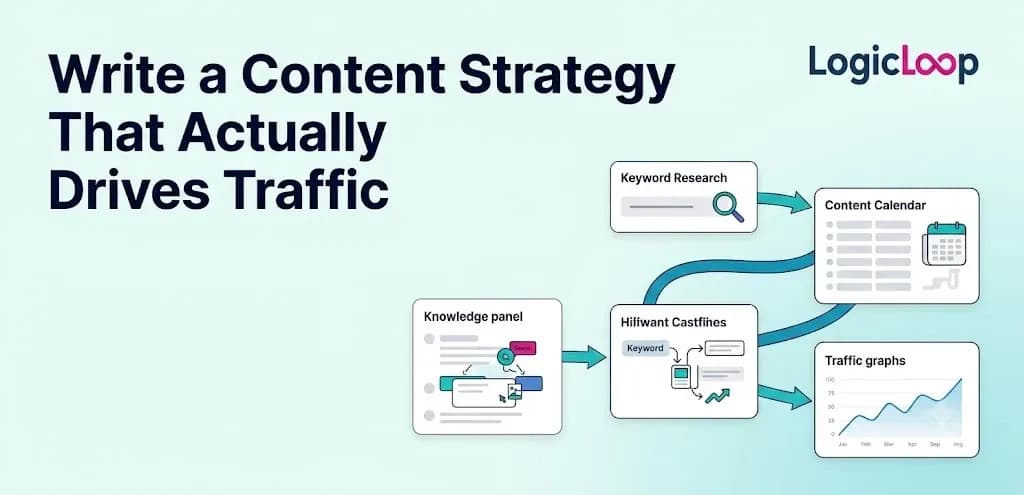
Most companies don't have a content strategy. They have a publishing habit. Someone writes a blog post when there's a free afternoon, a freelancer gets hired to hit a monthly quota, and half a year later the whole team is squinting at a traffic graph that looks like a flat line with a slight droop at the end.
That's not really a strategy problem. It's the absence of one.
This guide walks through how to build a content strategy that ties every post back to something the business actually needs, so you stop producing content and start producing results. Let's get into it.
Key Takeaways
- Start with a business goal, not a blog topic. Content that isn't anchored to a goal is just noise.
- Define who you're writing for using real data, and map topics to where they sit in the buying journey.
- Audit what you've already published before you make anything new.
- Distribution isn't optional. Getting a piece seen is roughly half the job.
- Measure outcomes tied to your goal, and give the work at least 90 days before you judge it.
What a Content Strategy Actually Is (and Why It Matters)
People throw around "content strategy" and "content marketing strategy" like they're the same thing. In casual conversation, fine. But there's a real distinction worth knowing, and it changes how you plan.
Content strategy is the big picture. It's the planning, creation, publication, management, and ongoing governance of everything you produce, plus the rules and reasoning behind all of it. Content marketing is the execution layer sitting underneath, the actual blog posts, videos, and social captions that get made and shipped.
You can't have good content marketing without a strategy behind it. Plenty of companies try anyway, and that's exactly why so much content underperforms.
Here's a scene that plays out constantly. A founder decides the company needs "more content," so a writer starts publishing twice a week on whatever seems interesting that day: a customer trend, a competitor's move, an industry news story. Three months in, they've got 26 posts, a trickle of visitors, and zero new customers who can point to the blog as the reason they signed up.
Now compare that to a company that picks one clear goal. Say, cutting down the sales calls wasted on explaining a confusing pricing model. They build content specifically to answer the questions that come up on those calls, aimed at the exact people having them. One approach produces content. The other produces revenue. The gap between them is strategy.
Start With a Business Goal, Not a Content Idea
The single biggest mistake in content planning is opening with "what should we write about" instead of "what does the business need." A content plan only works when it's anchored to something the company is actually trying to achieve.
That might be more demo requests. Better retention among existing customers. Credibility in a niche where nobody knows your name yet. Or something as unglamorous as reducing how often the support team answers the same five questions.
Make the Goal SMART
The SMART framework gets mentioned constantly here, and for good reason. Goals need to be specific, measurable, attainable, relevant, and time-bound.
"Grow traffic" isn't a goal. It's a wish. Something like "increase organic sign-ups from blog traffic by 15% over the next two quarters by targeting mid-funnel comparison searches" is a goal you can plan against, track, and eventually give a straight yes or no.
Once that goal exists, every decision downstream gets easier. Which topics matter. Which formats make sense. What "success" even means for a given post. Skip this step and you'll end up with a calendar full of ideas that felt great in a brainstorm but add up to nothing when you zoom out.
Know Who You're Actually Writing For
Audience work is where a lot of strategies get lazy. A team writes a one-paragraph buyer persona, drops it into a slide deck, and never opens it again. Real audience definition goes deeper than a job title. It means understanding what someone is actually searching for, and why, at each stage of their decision.
Think in terms of the customer buying journey, the path someone travels from first noticing a problem to becoming a repeat customer who recommends you to others.
- Early stage: they've just realized they have a problem and want to understand it.
- Middle stage: they're comparing options and weighing tradeoffs.
- Late stage: they're looking for reassurance that they're making the right call.
A single blog post rarely serves all three stages well. That's why real strategy work maps specific topics to specific stages, instead of writing generically "about" a subject and hoping it lands somewhere useful.
Match the Content to Search Intent
Search intent, what someone actually wants when they type a query, deserves just as much attention. Someone searching "what is a content strategy" wants an explainer. Someone searching "content strategy template" wants something they can download and use in the next five minutes.
Writing the wrong content type for the intent behind a keyword is a quiet, common way that otherwise decent articles fail to rank or convert. The topic was fine. The format missed.
| Search Query | Intent | What to Publish |
|---|---|---|
| "what is a content strategy" | Informational | Explainer article or guide |
| "content strategy template" | Transactional / tool | Downloadable template or checklist |
| "content strategy vs content marketing" | Comparison | Side-by-side breakdown |
| "how to write a content strategy" | How-to | Step-by-step walkthrough |
Building Personas That Hold Up
A useful persona isn't a name and a stock photo. It's built from actual data: sales call notes, support tickets, survey responses, and search behavior.
What do prospects ask right before they buy? What do they ask right after, when they're confused about how something works? Those questions make far better content prompts than anything a team invents in a conference room.
Pro Tip: Keep a running doc of the exact questions prospects ask on sales calls. Word for word. That list is a content calendar hiding in plain sight, and it's already validated by real buyers.
Audit What You Already Have Before Making More
Before you add anything new, take stock of what already exists. A content audit is basically a stock-take. You go through everything you've published and sort it by what's performing, what's stagnant, and what's actively outdated or wrong.
Skip this and you risk publishing a new article on a topic you already half-covered two years ago. Now you've split your own authority across two competing pages instead of consolidating it into one strong one.
Most audits turn up four buckets:
- Working content that just needs a light refresh.
- Underperformers with potential, held back by weak optimization or no promotion.
- Gaps, topics that matter where you have nothing at all.
- Dead weight that should be merged, redirected, or removed.
That last category surprises people. Not every post deserves to live on your site forever. Some pieces actively hurt your credibility by sitting there stale, and pruning them can help more than it hurts.
One thing that stays underrated: updating and expanding older content instead of only chasing new topics. Search engines reward freshness and depth, and an old post with existing backlinks and search history often outperforms a brand-new page on the same topic for months. It's already got a head start. Use it.
Choose Topics With a Method, Not a Mood
Keyword research is the obvious tool, and it matters, but it's not the whole picture. Strong topic selection weighs several things at once:
- Is the topic genuinely relevant to your business?
- Is there a realistic search opportunity, or is the term hopelessly competitive?
- How close does it sit to a real conversion? Is this a near-buyer's search, or someone five steps away from ever considering you?
- Do you have something genuinely different to say versus what already ranks?
That last point gets less credit than it deserves. High search volume on a topic a dozen competitors have already covered thoroughly isn't automatically a good target. High-intent, lower-volume searches from people close to a decision often deliver more business value than broad traffic that never turns into anything.
Where Pillar Content Fits
This is also where pillar content comes in. You build one comprehensive, authoritative piece on a core topic, then link out to a cluster of narrower articles that each cover a specific angle.
Done well, it signals topical depth to search engines and gives readers a clear path to go deeper on whatever question brought them in. Done poorly, it's just a big page with a pile of internal links stapled on. The difference is whether the cluster actually maps to how a real person would want to explore the subject.
Build a Calendar You Can Actually Sustain
An editorial calendar is where strategy turns into a routine you can run week after week. It doesn't need to be fancy. A spreadsheet with topic, target keyword, format, owner, due date, and publish date covers most teams. The tool matters far less than the discipline of keeping a rhythm you can maintain.
This is where ambition quietly sabotages everything. Teams commit to publishing three times a week because it sounds impressive, then burn out by month two and go silent. That's worse for search performance than a slower, steady pace would have been.
Pro Tip: One solid, well-researched piece every two weeks beats a three-a-week sprint that collapses in a month. Consistency and quality together do more work than either one alone.
Leave the calendar room to breathe. Keep space for content tied to real business moments: a product launch, a seasonal trend, a news story worth reacting to fast. A calendar planned three months out in rigid detail, with no flexibility, tends to produce content that feels disconnected from whatever's actually happening around it.
Don't Publish and Walk Away
Distribution, the channels and methods you use to get content in front of people after it's live, is where a lot of good strategies quietly fall apart. Writing the piece is maybe half the job. Getting it seen is the other half, and it's the half most often skipped because it's less satisfying than drafting something new.
There's an old rule of thumb that you should spend roughly as much time promoting a piece as you spent creating it, sometimes framed as an 80/20 split favoring promotion. Whatever the exact ratio, the point holds. A piece sitting on a blog with no promotion is depending entirely on search engines to find it, which can take months even for genuinely strong content, and often never happens at all for the decent-but-unremarkable stuff.
Practical distribution looks like this:
- Email newsletters to the subscribers you already have.
- Sharing on the social platforms your audience actually uses, not every platform that exists.
- Reaching out to people or publications who might link to or reference the piece.
- Repurposing the core ideas into other formats: a short video, a slide breakdown, a few quote graphics.
None of this has to be elaborate. It just has to happen, consistently, as a real step in the process rather than an afterthought you squeeze in if there's time left over.
Internal Linking Is Distribution Too
It's easy to forget that your own website is a distribution channel. Every new piece is a chance to link back to older, related articles, passing along relevance and helping visitors find more of what you've published.
Sites with strong internal linking tend to keep engaged readers around longer and get more pages per visit. That's its own positive signal about the value of the site as a whole.
Here's a quick checklist to run before you hit publish:
- Piece is mapped to a specific business goal
- Format matches the search intent behind the target keyword
- At least two internal links to related older posts
- Scheduled for email and the right social channels
- Repurposing plan noted (video, slides, or graphics)
- One outreach target identified for a possible link or share
Measure Outcomes, Not Just Activity
Traffic is easy to track and satisfying to watch climb. But traffic alone doesn't pay anyone's salary. A strategy tied to a real goal has to measure the things that connect back to that goal: qualified leads, trial sign-ups, email subscriptions, deals influenced, or a measurable drop in repetitive support tickets, depending on what you set out to do.
Patience matters more here than most teams expect. Content, especially content built around organic search, tends to compound rather than spike. A reasonable minimum before judging whether something's working is around 90 days, and longer for competitive topics.
Checking results after two weeks and declaring the strategy a failure is one of the most common ways good strategies get killed before they've had a real chance.
Set a Review Rhythm
Build a habit of reviewing performance on a cycle. Monthly works for most teams, with a fuller strategic check-in each quarter. Look at which topics and formats are actually driving the outcomes you care about, and be honest about the ones that aren't, even the pieces that were your personal favorites to write.
Common Mistakes to Avoid
Even experienced teams fall into the same traps. Here are the ones worth watching for:
| Mistake | Why It Hurts | Do This Instead |
|---|---|---|
| Starting with topics, not goals | Produces disconnected content | Anchor every piece to a business goal |
| Vague, thin personas | You write for no one in particular | Build personas from real sales and support data |
| Skipping the content audit | You cannibalize your own rankings | Audit and consolidate before adding new pages |
| Chasing high-volume keywords only | Traffic that never converts | Weigh intent and proximity to a decision |
| Publish-and-forget | Great content nobody sees | Treat distribution as half the job |
| Judging results in two weeks | Kills strategies too early | Give it 90 days minimum |
Keep the Strategy Alive
A content strategy document that gets written once and never touched again isn't a strategy anymore. It's a historical artifact.
Search behavior shifts. Competitors publish new material. Your own business goals change as the company grows. The strongest content operations treat the strategy as something to revisit on purpose, not something to set and forget.
That doesn't mean rewriting the whole plan every quarter. It means checking whether the goal is still the right one, whether the audience definition still matches who's actually showing up, and whether the topics still connect to what the business needs. A strategy that flexes with real feedback beats one frozen in a slide deck from January.
Frequently Asked Questions
What's the difference between a content strategy and a content marketing strategy?
Content strategy is the big-picture plan: how you create, publish, manage, and govern everything you produce, plus the reasoning behind it. Content marketing is the execution layer, the actual posts, videos, and captions. You need the strategy first; the marketing is how it gets carried out.
Where should I start when building a content strategy?
Start with a business goal, not a blog topic. Decide what the company actually needs, whether that's more demo requests, better retention, or fewer repetitive support tickets, then build content to serve it. Make that goal SMART so you can measure it later.
How do I choose which topics to write about?
Weigh four things together: relevance to your business, realistic search opportunity, how close the topic sits to a conversion, and whether you have something different to say versus what already ranks. High volume alone isn't enough. High-intent searches from people near a decision often deliver more value.
What is a content audit and why does it matter?
A content audit is a stock-take of everything you've published, sorted into what's working, what's underperforming, where the gaps are, and what's dead weight. It stops you from splitting your own authority across competing pages and often reveals older posts worth refreshing instead of replacing.
How often should I publish?
Whatever pace you can actually sustain. One well-researched piece every two weeks beats three a week for a month followed by silence. Search engines reward consistency, and burnout helps no one. Pick a cadence you can hold and keep it.
How important is search intent?
Very. Matching your format to what a searcher actually wants is often the difference between an article that ranks and one that doesn't. Someone searching "what is X" wants an explainer; someone searching "X template" wants a tool. Same topic, different content.
How much time should I spend promoting content?
A common rule of thumb is to spend about as much time promoting a piece as you spent creating it, sometimes framed as an 80/20 split favoring promotion. The exact ratio matters less than the principle: content without distribution depends entirely on search engines to find it, which is slow and unreliable.
How long before I know if my content strategy is working?
Give it at least 90 days, and longer for competitive topics. Content built around organic search compounds over time rather than spiking. Judging results after two weeks is one of the fastest ways to abandon a strategy that just needed more time.
What metrics should I actually track?
Track the outcomes tied to your original goal: qualified leads, trial sign-ups, email subscriptions, deals influenced, or reduced support tickets. Traffic is easy to watch but doesn't pay the bills on its own. Measure what connects back to the business.
Do I need pillar content and clusters?
They help when done right. A pillar piece on a core topic, linked to a cluster of narrower articles, signals depth to search engines and gives readers a path to go deeper. Just make sure the cluster maps to how someone would naturally explore the subject, not a pile of links for their own sake.
Final Thoughts
The difference between content that fills a calendar and content that drives traffic almost always comes down to one thing: whether there's a strategy underneath it. Start with a business goal. Know exactly who you're writing for. Audit before you build, pick topics with a method, distribute like it matters, and measure the outcomes that connect back to the goal you set.
None of this is complicated. It just takes the discipline to plan before you publish, and the patience to let the work compound. Do that, and a year from now you'll have a blog that earns its place instead of a graph that flatlines. If you'd like a hand turning any of this into a plan your team can run, the folks at Logicloop are happy to help.
Popular Searches:
Digital Marketing Agency | Brand Strategy Agency | Influencer Marketing Agency | Google Ads Management Agency | Facebook Ads Agency | Instagram Ads Agency | Performance Marketing Agency | Website Development Company | SEO services in Mumbai