
Blogs
How to Rank in Google Maps: The Local Pack Ranking Factors That Actually Move You Up
Author : Logicloop admin
Publish Date : 2026-07-28
Dave has run a plumbing business in Tulsa for eleven years. Solid 4.9-star average across 140 reviews, a website that loads fast, and vans he keeps spotless because, let's be honest, a dirty van doesn't exactly scream "trust me with your pipes."
Search "plumber near me" from three miles away and he shows up third. Search it from across town and he's gone. Vanished. His nephew, who runs his "SEO" as a weekend side hustle, told him to cram more keywords into his business name on Google. That's not just bad advice. It's the kind of move that gets a listing suspended.
So if you own a local business and you've watched a competitor with fewer reviews and an uglier website keep beating you on the map, stick around. Ranking in Google Maps isn't luck, and it isn't about clever tricks. It comes down to a specific set of signals Google has told us about directly, plus a layer of practical factors that local SEO firms have reverse-engineered through years of testing.
Key Takeaways
- Google ranks the local pack on three named factors: relevance, distance, and prominence.
- You can't buy your way into the map pack. Ads don't touch your ranking.
- Your Google Business Profile and your reviews carry more weight than your website copy.
- Small stuff moves the needle: photos, accurate hours, and replying to reviews.
- Nothing here works overnight. Realistic timelines run 60 to 90 days, longer in competitive markets.
What the Local Pack Actually Is
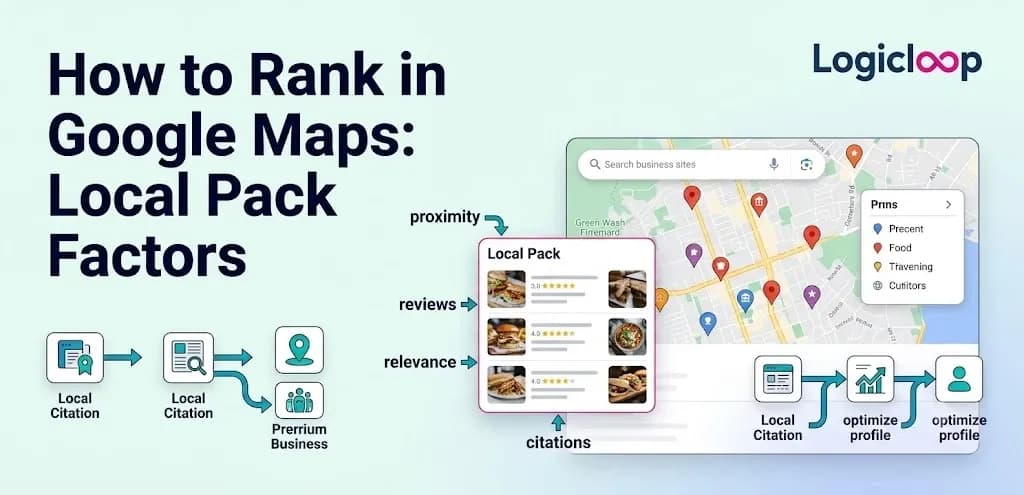
When you search something with local intent, like "coffee shop open now" or "emergency plumber," Google usually drops a box near the top with a map and three business listings under it. That's the local pack, sometimes called the map pack or the 3-pack.
It shows each business's name, star rating, category, hours, and often a phone number or "directions" button. All of that gets pulled straight from the business's Google Business Profile. No separate submission, no magic. Whatever's on your profile is what shows up here.
Here's why it matters more than most owners think. It sits above the traditional blue links, it's what people tap first on mobile, and it converts. Search Engine Land's guide to the local pack notes that businesses landing in it earn 126% more traffic and 93% more actions (calls, clicks, direction requests) than businesses in positions four through ten.
Locafy's research pushes it further. The local pack pulls in over 44% of clicks on local search pages, and it shows up in 93% of searches with local intent. Read that again. If you're not in the box, you're basically invisible for local searches, no matter how sharp your website looks.
The Three Factors Google Actually Names
Google, in its own Business Profile help docs, is refreshingly direct about this. Local ranking comes down to three things: relevance, distance, and prominence. Everything else you'll ever read about local SEO is really just tactics for nudging those three.
Let me break them down, because the details are where people trip up.
| Factor | What it means | How much control you have |
|---|---|---|
| Relevance | How well your profile matches what someone typed | High — category, description, services, reviews |
| Distance | How far you are from the searcher or search location | Low — you can't move closer to someone's house |
| Prominence | How known and trusted you are, online and off | Medium to high, but it takes time |
Relevance
Relevance is how well your profile matches the exact thing someone searched. Google reads your primary category, your business description, your services, and even the words customers use in reviews to decide whether you fit "emergency plumber" versus "bathroom remodel contractor."
For Dave, that means his primary category needs to say Plumber, not the vaguer "Contractor." And his profile has to actually list emergency services if that's what he wants to rank for. Whitespark's 2026 industry survey, cited by iMark Infotech, found the primary GBP category is the single most important local ranking factor, full stop. Get that one wrong and nothing else fully compensates.
Distance
Distance, which most local SEO writing calls proximity, is exactly what it sounds like. How far your business sits from the searcher, or from a location baked into the query itself, like "plumber in Broken Arrow." Google uses the searcher's real location when it has it and guesses when it doesn't.
This is the one factor you genuinely can't optimize around. You can't bribe your way closer to somebody's kitchen. What you can shape is how your address and service area are set up.
A brick-and-mortar coffee shop should show its exact address, because foot traffic depends on people finding the door. A plumber who drives to jobs is usually better off hiding the storefront address and defining a service area instead. A visible address on a service-area business can actually confuse Google about where you really operate.
Prominence
Prominence is how well-known and trusted your business is, both on the web and, in Google's own words, offline. Google ties this to two things specifically: links pointing to your business from other sites, and the number and quality of your reviews.
A business with a long track record, a strong review profile, and mentions scattered across the web will usually outrank a newer, thinner listing, even one that's technically closer. This is the factor that takes the longest to build. It's also the one most local SEO strategy is built around, because unlike distance, you have real control here.
Pro Tip: Google is blunt about one thing. There is no way to pay for a better spot in the local pack. No amount of Google Ads spend moves your map ranking. That surprises a lot of owners who assume Maps works like search ads. It doesn't.
What the Data Says Actually Moves the Needle
Google's three-factor framework is the foundation, but it's abstract. Local SEO agencies have spent years surveying rankings and testing changes to figure out which concrete actions carry the most weight inside "relevance" and "prominence."
BrightLocal's ongoing local ranking factors research, which pools input from local SEO practitioners, breaks the influence down roughly like this:
| Signal | Approximate weight |
|---|---|
| Google Business Profile signals | ~32% |
| Reviews | ~20% |
| On-page website signals | ~15% |
| Behavioral signals | ~9% |
| Link signals | ~8% |
| Citations | ~6% |
| Social signals | ~5% |
Two shifts in that data stand out. Reviews have grown in importance, climbing from around 16% a few years ago to 20% now. On-page signals, meanwhile, have shrunk a bit, from roughly 19% down to 15%.
Put those together and the story's clear. Google is leaning harder on your profile and what customers say about you, and slightly less on what your own website claims. Your site still matters (especially for the organic listings below the map pack), but if you've only got an hour, spend it on your profile and reviews, not another round of website copywriting.
Reviews: Quantity, Quality, and Velocity
Reviews sit at the heart of prominence, and they're the factor most owners can influence fastest. A few specifics matter way more than a vague "get more reviews."
Volume has a threshold effect. Research cited by Local Dominator found a noticeable ranking bump specifically when a business crosses from nine reviews to ten. It seems Google treats double digits as a real signal of legitimacy. Locafy's data goes further, finding that top-three local pack businesses average 47% more reviews than those stuck in positions four through ten.
Star rating has a trust ceiling in customers' eyes, even if not always in Google's. Research referenced by Maria Espie Vidal found that 80% of consumers only trust businesses rated four stars or higher. So a 3.8-star average can quietly cap your click-through rate even when your ranking position is fine.
Velocity matters, not just total count. Review velocity is simply the pace at which new reviews arrive over time, versus a pile you gathered once and never touched again. A business earning a handful of fresh reviews every month looks active. One that scored fifty reviews in 2021 and nothing since looks stalled. Locafy suggests aiming for roughly four to eight new reviews a month with a rating staying above 4.5 stars in competitive markets.
Responding isn't optional politeness, it's a trust signal. Vidal's research found businesses that reply to reviews come across as 1.7 times more trustworthy, and that 40% of consumers expect a response within 24 hours. For Dave, when someone mentions "water heater installation" in a review, replying with a short, specific note (not a copy-pasted "thanks for the review!") reinforces relevance too. Google reads the language in both the review and the reply.
A Quick Review Checklist
- Set your primary category correctly (this comes first, always)
- Ask every happy customer for a review the day the job wraps
- Aim for a steady four to eight new reviews a month
- Keep your average above 4.5 stars where you can
- Reply to every review within 24 hours, with something specific
Citations and NAP Consistency
A citation is any mention of your business's name, address, and phone number on another site, whether or not it links back to you. Think Yelp, Yellow Pages, industry directories, chamber of commerce listings, even old directory profiles you forgot you created.
NAP consistency means your Name, Address, and Phone number match exactly everywhere they appear. It matters because mismatched citations, like "123 Main St." on one directory and "123 Main Street, Suite B" on another, create doubt for Google about which details are correct.
BrightLocal and The Hoth both put citation signals in the single-digit percentage range on their own. Sounds small, sure. But citations also feed prominence indirectly, reinforcing that a business is a real, established entity with a consistent footprint across the web.
Photos, Posts, and Profile Completeness
This is the part of Google Maps SEO that's genuinely low-effort and constantly ignored. iMark Infotech's research found that profiles with photos get 42% more direction requests and 35% more click-throughs to their website than profiles without them.
Locafy recommends aiming for at least 25 photos and a description that uses close to the full 750-word limit Google allows. Cover services, specialties, and neighborhoods served in plain language, not a keyword list. Google can tell the difference, and so can the human reading it.
Then there are Google Business Profile posts, the short updates you publish straight to your listing under categories like offers, events, or "what's new." These seem to work as a freshness signal. A profile that hasn't posted in eight months reads as neglected. One with a post from last week reads as alive.
For a coffee shop, that might be a weekly note about a seasonal drink. For Dave, it could be a monthly maintenance tip or a seasonal reminder to winterize pipes before the first freeze.
Don't Sleep on Business Hours
Hours deserve their own callout, because their weight has jumped. Local Dominator's research found that operating hours became a very strong signal since late 2023, to the point where Google may filter a business out of results entirely if it's marked closed, or if its hours are stale and don't match reality.
If Dave's holiday hours from two years ago are still sitting on his profile, that's not cosmetic. It can knock him out of contention during the exact hours people are frantically searching for an emergency plumber.
Website Signals That Still Matter
On-page weight has eased slightly in favor of profile and review signals, but your website isn't irrelevant. A few things still pull real weight.
- Add LocalBusiness schema markup. This is structured data that flat-out tells Google your business type, address, hours, and service area in a format it can parse without guessing. It helps close the gap between what your site says and what your profile says.
- Build location-specific service pages. Especially if you cover more than one town or neighborhood. A single homepage trying to rank for five service areas usually loses to a competitor with five dedicated pages.
- Nail the fundamentals. A site that loads slowly or breaks on mobile undercuts the behavioral signals Google watches, like whether people bounce straight back to the results after clicking through.
Backlinks, But the Local Kind
Generic backlinks from unrelated blogs don't do much for local pack ranking. What actually helps is links that are geographically and contextually relevant.
A mention from the local chamber of commerce. A sponsorship writeup from the youth sports league Dave's company backs. A feature in the neighborhood paper. These do double duty, contributing to prominence directly and often arriving bundled with a citation, since local writeups tend to include the business name, address, and phone as a matter of habit.
Common Mistakes That Quietly Sink Your Ranking
- Keyword-stuffing your business name. It can get your listing suspended, exactly what Dave's nephew nearly caused.
- Showing a home address on a service-area business. It confuses Google about where you operate.
- Letting hours go stale. Old holiday hours can filter you out during peak search times.
- Collecting reviews in bursts, then going silent. Velocity beats a one-time pile.
- Ignoring review replies. You're leaving a trust and relevance signal on the table.
- Expecting Ads to help. They won't touch your map ranking. Not a dollar of it.
A Real-World Example: Back to Dave
So what actually moved Dave's ranking? Not a keyword-stuffed business name. Not some mystery algorithm hack his nephew swore by.
It was four unglamorous things. He fixed his primary category. He hid his home-based address in favor of a defined service area. He started asking every satisfied customer for a review the same day the job finished, instead of hoping they'd remember later. And he replied to every single review with something specific about the actual job.
Six months in, he was showing up third from across town too. Not because he found a shortcut, but because he stopped ignoring the parts of his profile Google was already telling him mattered.
Setting Realistic Expectations
None of this flips overnight, and anyone promising otherwise is selling something. Locafy's data suggests most businesses see measurable improvement within 60 to 90 days of consistent work.
Genuinely competitive markets are slower. Think plumbers in a big metro rather than a small town. Those can take six to twelve months to climb into the top three. Share that timeline with an owner up front, because the folks who quit review requests and profile updates after three weeks are exactly the ones who never see the payoff.
Frequently Asked Questions
How long does it take to rank in the Google Maps local pack?
Most businesses see measurable movement within 60 to 90 days of consistent work, according to Locafy's data. Competitive markets, like plumbers in a large metro, can take six to twelve months to reach the top three.
Can I pay Google to rank higher in the map pack?
No. Google is explicit that there's no way to buy a better local pack position. Google Ads spend does not move your organic map ranking at all.
What's the single most important local ranking factor?
Your primary Google Business Profile category. Whitespark's 2026 survey, cited by iMark Infotech, found it's the most important factor, and getting it wrong is hard to fully compensate for.
How many reviews do I need to rank well?
There's a noticeable boost when you cross from nine to ten reviews, per research cited by Local Dominator. Beyond that, top-three businesses average 47% more reviews than those in positions four through ten, so more genuinely helps.
Does my star rating affect rankings or just conversions?
Both, in different ways. Rating influences trust and click-through heavily. Research referenced by Maria Espie Vidal found 80% of consumers only trust businesses rated four stars or higher, so a low rating can cap clicks even with good positioning.
What is NAP consistency and why does it matter?
NAP stands for Name, Address, and Phone number. Consistency means those details match exactly across every site they appear on. Mismatches create doubt for Google about which information is correct, which can weaken your prominence.
Should a service-area business show its address?
Usually no. If you drive to customers rather than having them visit you, defining a service area instead of showing a physical address avoids confusing Google about where you operate. A storefront that relies on foot traffic should show its exact address.
How often should I get new reviews?
Locafy suggests roughly four to eight new reviews a month in competitive markets, with a rating that stays above 4.5 stars. Steady velocity signals an active, current business, which reads better than a burst of reviews years ago.
Do photos really affect Google Maps performance?
Yes. iMark Infotech's research found profiles with photos get 42% more direction requests and 35% more website click-throughs than profiles without. Locafy recommends at least 25 photos.
Do backlinks matter for local rankings?
Local, contextually relevant ones do. Links from a chamber of commerce, a local sponsorship writeup, or a neighborhood paper help prominence and often carry a citation with them. Generic links from unrelated blogs don't move much.
Final Thoughts
Ranking in Google Maps isn't a black box. Google told us the rules: relevance, distance, and prominence. The catch is that most of the payoff lives in the boring, consistent work, fixing your category, keeping your hours accurate, earning reviews steadily, and actually replying to them.
Dave didn't win with a trick. He won by paying attention to the profile Google was already handing him signals about. Start with your category and your reviews this week, keep at it for a quarter, and you'll be looking at real movement.
And if you'd rather have a team handle the grind of profile optimization, review strategy, and local citations for you, that's exactly the kind of work Logicloop does day in and day out. Reach out and let's get your business showing up where your customers are already looking.