
Blogs
How to Find Keywords That Rank AND Convert
Author : Logicloop admin
Publish Date : 2026-07-24
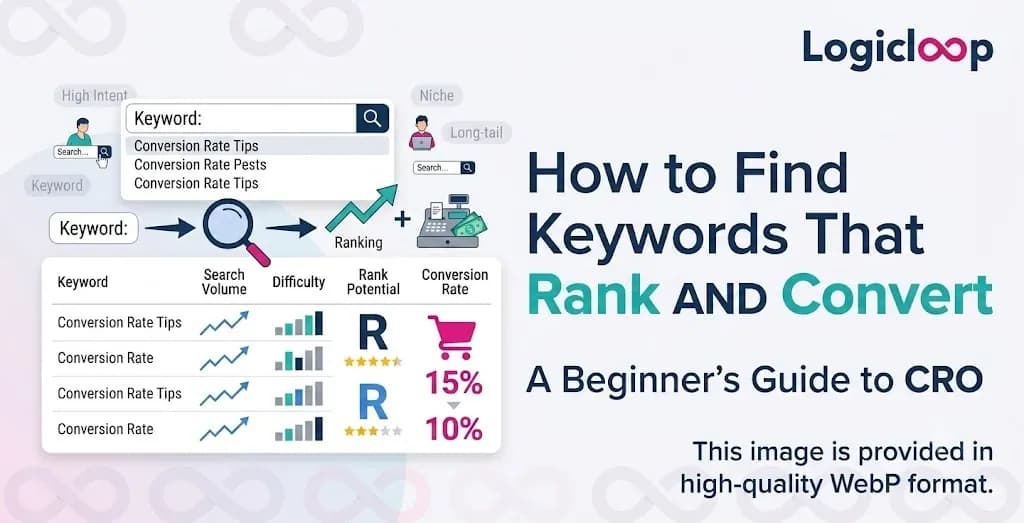
A client once showed me a keyword report from a previous agency: 340 keywords, all ranking on page one, traffic up 60% year over year. Revenue from organic search hadn't moved. Not a dollar. The team had done real work getting those rankings, but almost every term was informational: "what is," "how does," "types of." Great for a blog's ego, useless for a sales pipeline. That gap between ranking and revenue is the whole reason this article exists.
Most keyword research advice treats ranking as the finish line. Get the position, get the traffic, job done. But a page one ranking for a keyword nobody buys anything after searching is a vanity metric with extra steps. The real skill, and the harder one, is finding keywords that rank and convert at the same time: terms with enough search volume to be worth chasing, low enough competition that you can realistically win the spot, and enough commercial intent that the person searching is close to a decision, not just curious.
Ranking and converting are two different jobs
Search engine optimization (SEO, the practice of improving a page's position in unpaid search results) has trained a lot of marketers to chase one number: where you land on the search engine results page, or SERP, when someone types in a target term. That's a real goal. It's also an incomplete one.
Not every searcher wants the same thing, even when they type similar words. Someone searching "espresso machine reviews" is comparing options. Someone searching "buy Breville Barista Express" is done comparing and ready to hand over a credit card. Rank first for both terms and you'll get very different results in your analytics. The blog post about reviews might pull in ten times the traffic, but the product page will likely close more sales, because it's matched to what marketers call search intent, the actual goal behind a search query, not just the words used to express it.
HubSpot's keyword research guide, drawing on work from SEO strategist Zoe Ashbridge, breaks intent into four buckets: informational (someone learning or researching), navigational (someone trying to find a specific site or brand), commercial (someone comparing options before buying), and transactional (someone ready to buy right now). Ashbridge's framework is useful because it doesn't treat these as a hierarchy where transactional wins and everything else loses. It treats them as a funnel. You need informational content to build trust and get found early. You need commercial and transactional keywords to actually get paid. A site with only one or the other is either invisible or unprofitable.
Start with intent, not volume
The instinct when you open a keyword tool is to sort by search volume and grab everything above a certain threshold. That's backwards for anyone trying to find converting keywords rather than just traffic. Volume tells you how many people search a term monthly, on average. It says nothing about what happens after they search it.
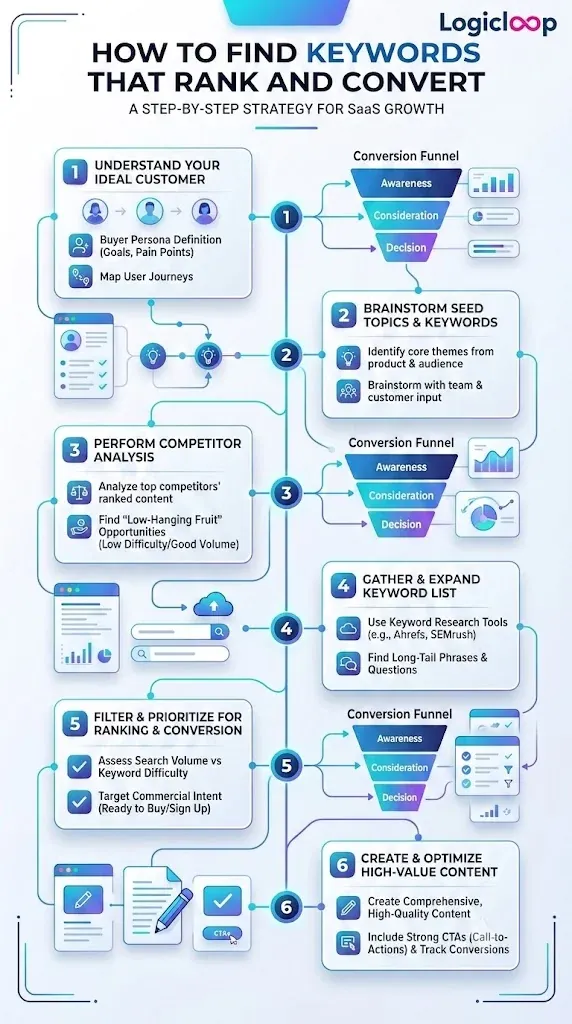
A better starting filter is intent, then volume, then difficulty. Commercial keywords tend to carry giveaway words: "best," "vs," "review," "alternative," "near me," "pricing," "for [use case]." Transactional keywords go further: "buy," "discount," "coupon," "order," "hire," a specific product or model name. These phrases often run three or more words long, which makes them long-tail keywords, a term for search phrases with more specific wording and typically lower monthly search volume than a broad, one or two word "head" term. A long-tail keyword like "affordable project management software for construction teams" will never pull the search volume of "project management software." But the person typing that longer phrase already knows what they need and is filtering for it. That's a much warmer lead than someone typing three words and browsing.
HubSpot's data gives a rough sense of scale here: for a newer site, a target of 100 to 1,000 monthly searches with a keyword difficulty score under 40 is a reasonable range to aim for. Keyword difficulty is a 0-100 score most tools use to estimate how hard it would be to rank on page one for a term, based mostly on the strength of the sites currently ranking there. Under 30 is generally winnable for a new or smaller site; 31 to 60 usually requires some established authority; anything above 80 tends to be dominated by major brands with years of backlinks behind them. Chasing a difficulty-80 commercial term with a six-month-old site is a good way to burn a year of content budget for nothing.
Where to actually find commercial keywords
This is the part where tools matter, and it's worth being specific about what each one is actually for, because they're not interchangeable.
Google Keyword Planner is still the starting point for a lot of research, mostly because the volume and bid data come straight from Google's own ad platform rather than a third-party estimate. It's built for advertisers, so you'll need a Google Ads account to access it, and the volume ranges it shows in the free tier are broader than what you get from paid tools. But for bid estimates, which double as a rough signal of commercial value (advertisers pay more for keywords that convert), it's hard to beat. If a keyword has a high suggested bid, someone with real ad budget has already tested that it makes money.
SE Ranking's keyword suggestion tool works well as a second pass. It pulls suggestions across categorized groups, similar terms, related terms, question-based terms, and lower-volume variants, and tags each with search intent, search volume, keyword difficulty, and cost-per-click (CPC, the average price advertisers pay per ad click, another proxy for commercial value). Running a seed term through it and sorting by intent tag is a fast way to separate the "buy now" terms from the "just browsing" terms without eyeballing every result.
KeywordTool.io takes a different approach entirely. Instead of pulling from ad platform data, it scrapes autocomplete suggestions, the predictions that pop up as you type into Google, YouTube, Amazon, Bing, and a dozen other platforms. That matters because autocomplete reflects what real people actually type, including phrasing your competitors' keyword tools might miss. It can return several hundred long-tail suggestions from a single seed term, which is genuinely useful for finding the specific, lower-competition phrasing that head-term tools miss entirely.
Once you have a list, you need to know if you can realistically win the ranking, not just whether the keyword exists. Ahrefs' free keyword rank checker will show you where a domain currently sits for a given term and let you see who's occupying the top spots, which is often more revealing than the keyword data itself. If the top five results are all sites with a decade of backlinks and enterprise budgets, that's information a difficulty score alone won't fully convey. Seobility's ranking checker does something similar on a smaller scale, free version included, and it strips out Google's personalization so you're seeing a neutral result rather than a version skewed by your own search history.
None of these tools replace judgment. They generate candidates. You still have to look at each keyword and ask: if I ranked number one for this tomorrow, would the person clicking through actually be close to buying what I sell?
Checking whether you're actually ranking
Once you've built and targeted a list, you need a way to check standing that isn't just typing the term into your own browser. Searching your own keyword in an open Google tab is close to useless, because Google personalizes results based on your location, search history, and account, so what you see isn't what a stranger sees.
Semrush's guide to checking Google rankings lays out three reliable methods. First, search in an incognito or private browser window, which strips out most personalization, though not location. Second, use Google Search Console, a free tool from Google that shows your site's average position for up to 1,000 queries it's tracked impressions and clicks for, directly from Google's own data rather than an estimate. Third, use a dedicated rank tracker, something like Semrush's Position Tracking, Ahrefs' Rank Tracker, or Seobility's monitoring tier, which checks your target list on a schedule and shows you movement over time rather than a single snapshot.
That third option matters more than it sounds like it should, because rankings move constantly. A term you held at position 4 last month can slide to position 11 after a competitor updates their page or Google rolls out an algorithm change, and you won't notice unless something is watching for you.
Match the page to the intent, or the ranking won't matter
Here's where a lot of otherwise solid keyword research falls apart: teams find a great commercial keyword, then send it to a blog post instead of a page built to convert. If the keyword says "buy" and the page says "here are ten things to consider," you'll get a bounce, not a sale.
Semrush's own list of ranking factors backs this up indirectly. Alongside backlinks, technical SEO, and content quality, they call out search intent alignment as a direct ranking factor, not just a conversion one. Google is increasingly good at noticing when a page technically contains a keyword but doesn't actually serve the reason someone searched it, and it will rank a worse-written page higher if that page matches intent more precisely. So the fix works both directions: transactional keywords need product or service pages with clear pricing and a next step, not another 2,000-word guide. Commercial keywords do well with comparison content, "X vs Y" pages, or buyer's guides that end in a recommendation. Informational keywords earn their keep by building topical authority and internal-linking toward the pages that actually make money, even if the blog post itself never converts a reader directly.
A quick example from a real research pass
Say you're running keyword research for a mid-size HVAC company. A broad head term like "HVAC repair" pulls big volume and equally big difficulty; a national directory or aggregator owns that spot and isn't giving it up. Run that seed through SE Ranking or KeywordTool.io and you start seeing variants like "AC not cooling but running," "furnace repair cost estimate," "emergency HVAC repair [city name]." Each one is lower volume individually. Together, and paired with service pages rather than blog posts, they represent people who already have a broken unit and a wallet open. That's the practical difference between chasing traffic and finding keywords that rank and convert: trading one big number you'll never win for a dozen smaller ones you actually can, aimed at people who are ready to act.
What AI search results are doing to this picture
It's worth naming a shift that's changing how much any of this ranking work actually matters for traffic. Semrush's research found meaningful overlap between traditional Google top-10 results and what AI tools cite: Perplexity pulled from Google's top 10 results 82.34% of the time in their sample, Google's own AI Overviews (the AI-generated summary that sometimes appears above normal search results) did so 67.39% of the time, Google's AI Mode 35.41%, and ChatGPT 27.73%. Ranking well in traditional search still feeds these AI answer boxes, which is one more reason not to abandon the fundamentals.
But Semrush also found that traditional search still drives noticeably more traffic than AI platforms do, at least for now. That's likely to keep shifting, and informational queries seem to be absorbed into AI overviews faster than commercial ones, since a chatbot can summarize "how does a heat pump work" a lot more easily than it can close a sale for a specific HVAC install. If anything, that raises the value of getting the commercial and transactional layer of your keyword strategy right, because that's the part least likely to get swallowed by a summary box anytime soon.
Where to start this week
Pull your existing keyword list, if you have one, and sort it by intent before you sort it by anything else. Kill or deprioritize anything purely informational that isn't linking toward a page that makes money. Then pick five commercial or transactional terms with a keyword difficulty your current site can realistically compete for, run them through Google Keyword Planner for a bid-based sanity check, and build one page for each that actually matches what the searcher wants to do next. Check your position again in three weeks, not tomorrow. Rankings for new or refreshed pages rarely settle before then, and judging too early is how good keyword strategy gets abandoned before it had a chance to work.

FAQ
1. What is the difference between ranking keywords and converting keywords?
Ranking keywords help your website appear in search results, while converting keywords attract users who are more likely to take action, such as making a purchase, filling out a form, or booking a service. The best SEO strategy balances both visibility and conversions.
2. How can I identify keywords with high conversion potential?
Look for keywords with commercial or transactional intent, such as "buy," "pricing," "best," "near me," or "hire." Combine intent analysis with search volume, keyword difficulty, and CPC data to find keywords that are more likely to generate leads or sales.
3. Are long-tail keywords better for conversions?
Yes. Long-tail keywords are more specific and usually reflect stronger purchase intent. Although they have lower search volume, they often deliver higher conversion rates because users know exactly what they're looking for.
4. Which keyword research tools are best for finding high-converting keywords?
Popular tools include Google Keyword Planner, SE Ranking, Ahrefs, Semrush, KeywordTool.io, and Google Search Console. Using multiple tools gives you better insights into search volume, keyword difficulty, intent, and competition.
5. Should I prioritize search volume or search intent?
Search intent should come first. A keyword with moderate search volume but strong buying intent often delivers better business results than a high-volume informational keyword that attracts visitors who aren't ready to convert.
6. What is a good keyword difficulty score for a new website?
For new or low-authority websites, targeting keywords with a difficulty score below 30–40 is generally more realistic. As your site's authority grows, you can gradually compete for more competitive keywords.
7. How do I know if my keyword strategy is working?
Track keyword rankings, organic traffic, click-through rate (CTR), conversions, leads, and revenue. Ranking improvements alone don't guarantee success unless they contribute to measurable business outcomes.
8. Can informational keywords still generate sales?
Yes. Informational content builds trust and attracts users at the beginning of the buyer journey. By linking these articles to relevant product or service pages, you can guide visitors toward conversion over time.
9. How often should I update my keyword research?
Review your keyword strategy every three to six months or whenever there are major changes in your industry, Google's algorithm, or customer search behavior. Regular updates help you identify new opportunities and maintain rankings.
10. How does AI search affect keyword research?
AI-powered search experiences are changing how users discover information, but search intent remains critical. Creating high-quality content that answers user questions while targeting commercial and transactional keywords improves your chances of appearing in both traditional search results and AI-generated responses.
Popular Searches:
Digital Marketing Agency | Brand Strategy Agency | Influencer Marketing Agency | Google Ads Management Agency | Facebook Ads Agency | Instagram Ads Agency | Performance Marketing Agency | Website Development Company | SEO services in Mumbai