
Blogs
How to Build E-E-A-T and Topical Authority (Without Faking Either)
Author : Logicloop admin
Publish Date : 2026-07-28
Two pages can cover the same topic, hit roughly the same word count, and chase the exact same keyword. One holds page one for months. The other never cracks the top fifty. Nine times out of ten, that gap isn't a broken meta tag or a slow server.
It's that Google's systems, and the human quality raters behind them, can usually tell which page came from someone who knows the subject and which one got assembled to fill a slot on a content calendar. The SEO world has a name for the quality that separates them: E-E-A-T. Stack it on top of topical authority, and you've got the two ideas that quietly decide who wins in search.
Neither one is a checkbox you tick once and forget. Think of it more like how a local business earns a reputation in a small town. One good outcome at a time, backed by people who vouch for you, until asking around keeps leading back to your door.
Key Takeaways
- E-E-A-T stands for experience, expertise, authoritativeness, and trustworthiness. It's a lens for judging content quality, not a direct ranking factor.
- Of the four, trust carries the most weight. The other three exist to feed into it.
- Topical authority comes from covering a subject deeply and linking that coverage together, not from publishing a big pile of loosely related posts.
- The two reinforce each other: depth gives Google room to recognize expertise, and expertise makes the whole cluster rank faster.
- Both are reputations built over time. Neither moves overnight, and neither can be faked at scale.
What E-E-A-T actually is (and what it isn't)
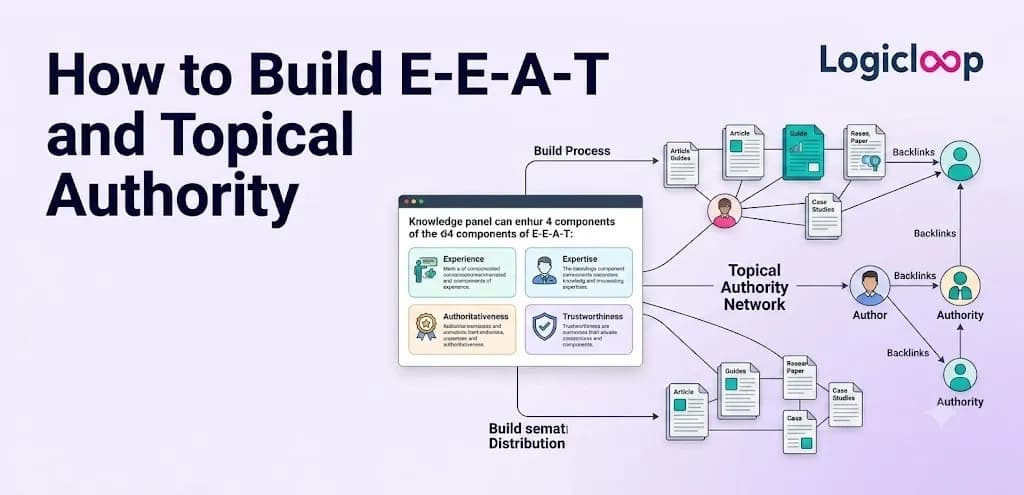
E-E-A-T stands for experience, expertise, authoritativeness, and trustworthiness. The term comes straight out of Google's Quality Rater Guidelines, a long internal document Google hands to thousands of contracted human evaluators around the world.
Here's the part most articles skip. Those raters don't write code, and they don't touch the algorithm. They manually score real search results against real queries and note whether the results look helpful, accurate, and trustworthy. Google uses that feedback the way a restaurant owner reads comment cards: not to change the recipe mid-service, but to check whether the kitchen is actually cooking what it thinks it's cooking. No rater can push a single page up or down.
So when someone tells you they "optimized a page for E-E-A-T" like flipping a switch, be a little skeptical. Google's own documentation on helpful, people-first content says plainly that E-E-A-T isn't a direct ranking factor. There's no dial in the algorithm labeled "trustworthiness" that your page trips.
What the ranking systems actually do is lean on a mix of signals that happen to line up with the qualities E-E-A-T describes. Who wrote the piece. Whether it's factually consistent. Whether reputable sources link to or cite it. Whether the site has any track record on the subject. E-E-A-T is the lens, not the lever.
Why trust does most of the heavy lifting
Of the four letters, trust matters most. Google has been direct about this: the other three qualities feed into trust rather than standing beside it as equals.
That's more useful than it sounds. A page doesn't need to max out experience, expertise, and authoritativeness all at once. It needs to land as trustworthy, and it can get there through different mixes of the other three.
- A first-person product review from someone who genuinely bought and used the thing can be trustworthy through experience alone, no formal credentials required.
- A medical explainer usually needs expertise and authoritativeness to earn the same trust, because personal anecdote isn't enough when someone's health is on the line.
The stakes change the rules
That last point ties into something most content plans underweight: stakes. Google applies noticeably stricter scrutiny to what it calls Your Money or Your Life (YMYL) topics, pages that could affect someone's health, finances, safety, or major life decisions.
A blog post about the best hiking trails near a city gets read loosely. A page about which supplements are safe to combine with blood thinners does not. Google gives more weight to strong E-E-A-T signals on that YMYL category specifically, which is exactly where an anonymous, unattributed article turns into a liability instead of just a missed opportunity.
A low-trust page vs. a high-trust page
It's easier to see the difference with two examples sitting side by side. Say you're searching for how to manage high blood pressure through diet.
Result one is a 600-word article with no author name anywhere on the page, published on a site whose "About" page is a single vague paragraph about a "wellness team." The writing reads fine on the surface, general advice, no obvious errors. But there's no way to verify who wrote it, what qualifies them, or where any of the claims came from. No byline (the line under the headline naming the writer), no author bio.
Result two covers similar ground, but it carries a byline naming a registered dietitian, a short bio linking to her credentials, and a note that a cardiologist medically reviewed the piece. It cites specific studies instead of hand-waving at "research shows." It even includes a brief aside about a patient case the dietitian worked through, the kind of detail that's hard to fabricate and signals real experience rather than research assembled secondhand.
Both pages might be factually accurate. Only one gives a reader, or Google's systems, any way to check.
| Low-trust page | High-trust page | |
|---|---|---|
| Author | None listed | Named registered dietitian |
| Credentials | Vague "wellness team" | Bio linking to real credentials |
| Review | None | Medically reviewed by a cardiologist |
| Sources | "Research shows…" | Specific cited studies |
| Experience signals | Generic advice | Real patient case referenced |
| Verifiability | Nothing traceable | Every claim traces to someone accountable |
This is where content authority gets built or lost, at the sentence level. It isn't really about disclaimers or trust badges glued to a footer. It's whether a reader can trace each claim back to someone accountable for it. Treat authorship as an afterthought and you're basically asking to be judged as anonymous, which is the hardest position to rank from on any topic where accuracy actually matters.
Topical authority: coverage has to connect, not just exist
Topical authority is the reputation a site earns as the go-to source on a subject by covering it thoroughly and linking that coverage together, so both readers and search engines can see how the pieces relate.
And no, it's not the same as publishing a lot of articles about a broad theme. A site with two hundred loosely related posts about "marketing" has no topical authority. A site with forty tightly connected pages about email deliverability, each answering a real question a marketer asks in sequence, usually does. Depth and connection beat volume.
Mediaplus frames the relationship neatly: topical authority shows what you cover deeply, and E-E-A-T shows how credible you are inside that coverage. They pull in the same direction. A cluster of in-depth, well-linked content gives Google more surface area to recognize expertise, and demonstrated expertise makes the whole cluster more likely to rank as a unit instead of one article at a time.
Pro Tip: Some in the industry call this the ranking multiplier effect. Once a site is recognized as authoritative on a topic, new pages inside that same topic tend to rank faster and higher than the identical page would if you published it cold on an unrelated domain. That's why finishing a cluster beats scattering ten posts across ten unrelated subjects.
The Ahrefs example that makes the case
Ahrefs illustrates this with a story worth remembering. A bicycle parts retailer with a fairly modest domain rating manages to outrank Amazon, a domain with enormous overall authority, for e-bike-related searches.
Amazon wins on raw site authority by a mile. What it doesn't have is topical depth on e-bikes specifically. The smaller, focused retailer covers the subject more completely, in more useful detail, connected across more relevant pages, and takes the specific topic despite losing badly on general authority.
That's the whole argument in one anecdote: depth in a narrow lane beats breadth spread thin.
The pillar and cluster structure that makes coverage legible
The standard way to build this is a hub-and-spoke (pillar and cluster) structure.
A pillar page gives a broad, thorough overview of the core topic. It often runs long, sometimes in the two-to-three-thousand-word range or more, because it needs room to touch every major subtopic without going deep on any single one. Cluster pages branch off it, each going deep on one subtopic the pillar only introduced.
Here's how the links flow:
- The pillar links out to every cluster page.
- Each cluster page links back to the pillar.
- Cluster pages link sideways to related cluster pages.
Done right, the whole group reads as one interconnected resource instead of a scattered pile of posts that happen to share a tag.
The research feeding this usually starts with a small set of seed keywords representing the core subject, then expands outward: what related questions people actually ask, what competitors have covered, where gaps sit uncovered by anyone. Innovkraft's take for 2026 pushes it further, arguing that topics should be mapped as entities and intent layers rather than flat keyword lists. Informational questions, commercial comparisons, and transactional decisions each need their own coverage in the same cluster, because a reader's questions change shape as they move from curious to ready to buy.
Content that demonstrates experience instead of claiming it
The "experience" in E-E-A-T does more work than it gets credit for. It's the difference between an article explaining how a tool works in theory and one written by someone who actually used the tool, hit its limits, and can tell you what went wrong.
Screenshots of a real dashboard. A specific number from a real campaign. A mistake the writer made and then corrected. These are hard to fake and easy to notice when they're missing.
Intelegencia points to a pattern worth taking seriously: AI-generated text with no author attribution tends to underperform against expert-led content that includes case studies and citations from specialists. That's not a reason to swear off AI for research or drafting. It means the finished piece needs a named, qualified person standing behind it, ideally shaping it, rather than a generic byline slapped onto text nobody reviewed.
The same source notes that a large share of Google searches now end with no click to any website at all, somewhere around 58.5% by one recent measurement. Which makes the searches that do produce a click even more worth winning, and you win them with genuinely differentiated, trustworthy content rather than a rehash of whatever's already ranking.
Signals that build authority beyond your own pages
None of this happens in a vacuum. Authoritativeness, the third piece, is partly about what other credible sources say about you.
Backlinks from sites that are themselves respected within your topic carry far more weight than a pile of low-relevance links from unrelated directories. A few external votes of confidence you can't fully manufacture on your own:
- Guest contributions to established publications in your field
- Mentions from journalists or industry analysts
- Citations in other people's research and reference content
This is where internal linking and external signals start feeding each other. A well-structured cluster gives outside sites something specific and useful to link to, instead of a homepage that says everything and nothing. Sites that earn citations almost always did the work of becoming genuinely useful references first. The links follow the usefulness, not the other way around.
Keeping content current instead of letting it rot
A pillar-and-cluster setup built once and never touched again slowly bleeds ground. Prices change. Tools get updated. Best practices shift. A page that was accurate two years ago can quietly become the least trustworthy result in the set without a single word changing.
Use a maintenance rhythm so a cluster looks tended rather than abandoned:
- Revisit older pages on a schedule instead of only when traffic drops
- Update stale figures, stats, and dates
- Replace outdated screenshots with current ones
- Fold in new subtopics as they emerge in the space
- Refresh internal links as new cluster pages go live
- Re-confirm that every claim still holds
Google's own guidance for self-assessing content quality includes asking who created it, how it was created, and why. Content nobody has revisited in years tends to fail that "why" question. If nobody cared enough to update it, why would a reader trust it over something fresher?
Common mistakes that quietly cap your rankings
- Publishing anonymously on high-stakes topics. On YMYL content especially, no author is a ranking liability, not a neutral choice.
- Mistaking volume for authority. Two hundred shallow posts don't beat forty connected ones.
- Orphaned cluster pages. Great articles that link to nothing and get linked from nothing waste the whole structure.
- Faking experience. Generic "in our experience" lines with zero specifics fool no one, readers or raters.
- Set-and-forget clusters. Content decays; unmaintained pages drift toward the bottom of the results.
- Chasing E-E-A-T as a switch. It's a byproduct of doing real work, not a setting.
Measuring whether the work is actually landing
The clearest signs that your E-E-A-T and topical authority efforts are paying off show up gradually, not in one dramatic spike:
- New pages within an established cluster start ranking faster than they used to.
- Organic traffic grows across the whole topic rather than jumping on one lucky post.
- Engagement metrics like time on page and return visits trend upward, because readers find what they came for.
- Backlinks from relevant, topically related sites grow, a sign the content is being treated as a reference and not just indexed.
None of these move overnight. That's consistent with what E-E-A-T and topical authority actually are: a reputation built through a long run of good decisions, not a toggle you flip before launch.
Frequently Asked Questions
Is E-E-A-T a ranking factor?
Not directly. Google's documentation says there's no single "E-E-A-T score" the algorithm reads off your page. Instead, the ranking systems use signals that correlate with experience, expertise, authoritativeness, and trust. Treat E-E-A-T as a lens for judging quality, not a lever you pull.
What does the extra "E" stand for?
Experience. It was added to the original E-A-T (expertise, authoritativeness, trustworthiness) to capture first-hand, been-there knowledge, like a real product review from someone who actually used the item, versus information gathered secondhand.
Which part of E-E-A-T matters most?
Trust. Google has said the other three qualities feed into trustworthiness rather than standing as equals. A page can reach "trustworthy" through different combinations, experience alone for a product review, expertise plus authoritativeness for a medical piece.
What is topical authority in plain terms?
It's the reputation a site earns as the obvious source on a subject by covering it deeply and linking that coverage together. It comes from connected depth, not from publishing a lot of loosely related articles under one broad theme.
How is topical authority different from E-E-A-T?
Topical authority shows what you cover deeply. E-E-A-T shows how credible you are within that coverage. They reinforce each other: depth gives Google more room to recognize expertise, and expertise helps the whole cluster rank as a unit.
How many articles do I need to build topical authority?
There's no magic count, and volume isn't the point. Forty tightly connected pages that each answer a real question in sequence usually beat two hundred loosely related ones. Aim for complete, connected coverage of a defined topic, not a target number.
What's a pillar and cluster structure?
A hub-and-spoke setup. The pillar page gives a broad overview of the core topic (often two to three thousand words). Cluster pages each go deep on one subtopic. The pillar links to every cluster, each cluster links back and sideways, and the whole thing reads as one resource.
Does using AI to write content hurt E-E-A-T?
Using AI for research or drafting isn't the problem. Publishing AI text with no named, qualified person behind it is. Attribution-free AI content tends to underperform against expert-led pieces with case studies and specialist citations. Keep a real, accountable author on the byline.
What are YMYL topics and why do they get stricter scrutiny?
YMYL stands for Your Money or Your Life, pages that could affect someone's health, finances, safety, or major decisions. Google weighs strong E-E-A-T signals more heavily here because the cost of bad information is higher. Anonymous content is especially risky on these topics.
How long does it take to see results?
Longer than most people want. New cluster pages ranking faster, topic-wide traffic growth, better engagement, and relevant backlinks all build gradually. E-E-A-T and topical authority behave like a reputation, earned over a run of good decisions, not switched on before a launch.
Final Thoughts
Strip away the jargon and both of these ideas come down to something a good editor already knows: put real, accountable expertise on the page, cover a subject completely enough to be genuinely useful, and connect that coverage so nobody, human or crawler, has to guess how the pieces fit.
Do that consistently and the signals Google actually measures start showing up on their own. You can't shortcut the reputation, but you can absolutely earn it, one well-made, well-connected page at a time. If you'd rather have a team map the clusters and build that authority with you, that's the kind of work Logicloop lives for.
Popular Searches:
Digital Marketing Agency | Brand Strategy Agency | Influencer Marketing Agency | Google Ads Management Agency | Facebook Ads Agency | Instagram Ads Agency | Performance Marketing Agency | Website Development Company | SEO services in Mumbai