
Blogs
Generative Engine Optimization (GEO): The Complete 2026 Guide
Author : Logicloop admin
Publish Date : 2026-07-28
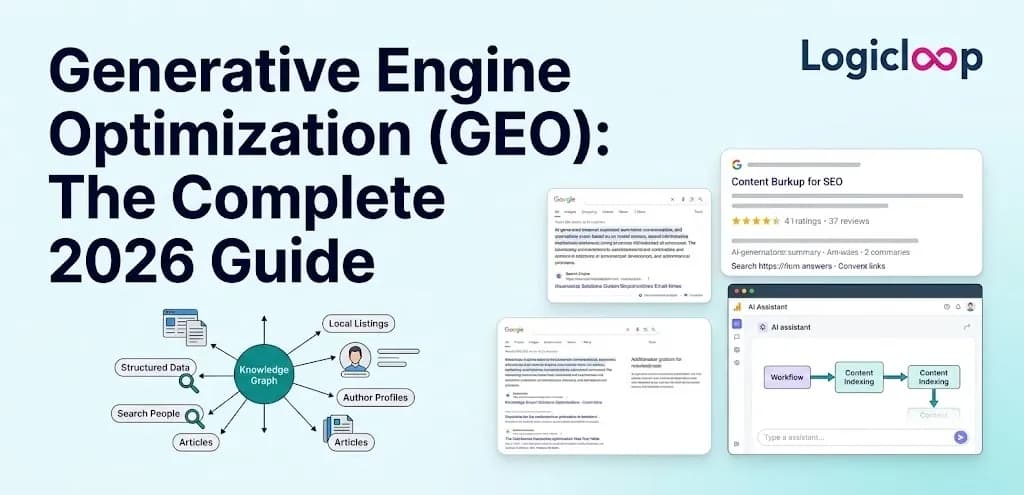
Ask ChatGPT which CRM suits a five-person startup, and you won't get a page of blue links to sift through. You'll get an actual answer, written out in a paragraph or two, with maybe three or four sources named along the way. That move, from a list of links to a synthesized response, is the whole reason marketers started taking generative engine optimization seriously instead of treating it as conference-panel jargon.
So let's talk about what it is, what actually moves the needle, and where the data still contradicts itself. Because it does contradict itself, and pretending otherwise would do you a disservice.
Key Takeaways
- GEO is the practice of shaping your content so AI systems like ChatGPT, Google's AI Overviews, Perplexity, and Claude pull it into their answers and cite you.
- It's a close relative of SEO, not a replacement for it. Strong fundamentals are the floor, not the ceiling.
- The public research on how AI citations map to traditional rankings is genuinely contradictory, with overlap figures ranging from roughly 8% to 90%.
- Structure, specificity, freshness, and third-party validation show up most consistently as signals that matter.
- Treat every percentage you read, including the ones here, as directional. Nobody outside these companies knows the exact formula.
What Is Generative Engine Optimization?
GEO, usually just said as three letters, is about getting AI systems to actually pull your material into the answers they generate, and ideally credit you when they do. Think ChatGPT, Google's AI Overviews, Perplexity, Claude, and the rest of that crowd.
It's a cousin of SEO (search engine optimization, the decades-old work of ranking pages higher in a traditional results list). But the target moved. Instead of fighting for position one on a results page, you're now trying to get quoted, paraphrased, or linked inside a paragraph an AI wrote in response to somebody's question.
You'll also hear it called AEO (answer engine optimization) or LLMO (LLM optimization, for the large language models that power these tools). The names overlap enough that arguing over which one is "correct" is a waste of a good afternoon. What matters is the behavior underneath.
Why It Matters
These systems don't just search and rank. They read, summarize, and respond in plain language, and they decide, query by query, which sources are worth pulling from. That's a different game than the one SEO taught most of us to play.
A large language model predicts likely sequences of words based on patterns it picked up during training. It isn't looking things up in a database the way a search index does. So most modern AI search tools pair the model with something called retrieval, often shortened to RAG (retrieval-augmented generation).
Rather than answering purely from memory, the system fetches current documents relevant to your question, then grounds its response in what it just pulled, attaching citations, the little source links you see beside an AI answer, back to the origin. Google's own developer docs describe this as the engine behind AI Overviews and AI Mode: retrieval keeps answers current and lets people click through to verify what they're reading.
You'll sometimes see "GEO SEO" used as one phrase. A bit redundant, sure, but it captures a truth. You can't really pull the two apart anymore. Crawlable pages, real expertise, a site that loads and works, those SEO fundamentals are the foundation AI systems build on.
How AI Systems Decide What to Cite
When someone types a question into an AI search tool, the request usually gets taken apart first. Google calls this query fan-out. The model spins up several related sub-queries behind the scenes to cover different angles, retrieves results for each, then writes one combined answer.
Google's documentation uses a lawn example. Someone asks how to fix a weedy lawn, and behind that single question the system might separately search for herbicide options and for weed-prevention methods, then merge what it finds.
That's a big part of why AI search feels so different from typing into a regular search box. One analysis found queries entered into AI tools run to roughly 23 words on average, versus about 4 words for a typical Google search. People also spend several minutes in an AI session, compared to the few seconds a normal search click tends to get. They're not just searching differently, they're asking differently, in fuller sentences with more context stapled on.
The Honest Part: Nobody Has the Formula
Here's where honesty beats confidence. Nobody outside these companies knows the exact ranking logic, and the public data on how closely AI citations track traditional rankings genuinely doesn't agree with itself.
| Source / analysis | Reported overlap with top traditional rankings |
|---|---|
| Seer Interactive, Search Engine Journal | ~87–90% of AI citations on already top-ranking pages |
| Ahrefs (overall) | ~12% overlap with Google's top ten |
| Ahrefs (ChatGPT specifically) | ~8% overlap |
| Separate trend estimate over time | ~70% declining to under 20% |
Those numbers don't reconcile cleanly, and that's worth sitting with rather than smoothing over. Different studies use different query sets, different industries, different snapshots in time. And the systems themselves get updated constantly, so a measurement from one month may not hold a few months later.
Anyone telling you they've cracked the precise formula is guessing. Might be an educated guess. Still a guess.
What Google Itself Says
It's worth slowing down on Google's own position, because it cuts hard against a lot of the GEO hype floating around. Google's developer guidance states plainly that SEO best practices still apply to AI features, and that no separate technique is required to show up in AI Overviews beyond doing normal optimization well: crawlable pages, semantic HTML, solid page experience, genuinely useful content instead of reworded summaries of what already exists.
More pointedly, Google explicitly names a handful of popular GEO tactics as not helping visibility in its systems.
- Publishing an llms.txt file
- Chopping content into tiny fragments on the theory that AI prefers bite-sized chunks
- Rewriting pages to sound more "AI-friendly" rather than more useful to people
- Chasing inauthentic brand mentions
- Over-investing in structured data as if it were a magic switch
Read that list as a reality check. GEO isn't some separate discipline with a secret rulebook. A lot of it is just SEO, aimed at a new surface.
That said, Google is one voice among several. Its guidance describes its own systems, not necessarily how Perplexity, ChatGPT, or Copilot make retrieval decisions. Those are built differently and run on different indexes.
The Signals That Actually Seem to Matter
Set the disagreements aside for a second. A few things show up consistently enough across sources that I'd prioritize them without much hand-wringing.
Structure That's Easy to Lift
Pages that open a section with a direct answer, use question-style headings that mirror how people actually ask, and lay out comparisons or steps cleanly tend to get pulled into AI answers more readily than dense, meandering prose that buries the point three paragraphs down.
This isn't about carpet-bombing a page with bullet points. It's about not making an AI system, or a human reader, hunt for the answer.
Specificity and Evidence
A study tied to Princeton researchers found that adding statistics, direct quotations, and citations to existing content lifted its visibility in AI-generated answers by somewhere around 30 to 40 percent in their testing. That's a meaningful effect, and it fits the broader pattern: AI systems, like careful readers, gravitate toward concrete content over vague generalities.
Pro Tip: Before you publish, gut-check each section against one question. "Does this give a reader something specific they can't get from a generic summary?" If a paragraph could appear on a hundred other sites unchanged, it's not earning its citation.
Freshness
Freshness comes up a lot. One analysis found pages older than about three months start seeing noticeably fewer citations. That tracks with the retrieval-based nature of these systems. If the model is pulling in current information, a stale page is a weaker bet than something recently updated.
Third-Party Validation
This one carries real weight. Multiple sources, including citation-bias analysis referenced by Search Engine Land, suggest AI systems lean toward earned coverage, mentions on outlets, forums, and review sites you don't own, over content on your own domain.
A glowing claim on your own site reads as marketing. The same claim on Reddit, in a trade publication, or on Wikipedia reads as evidence. That's why building genuine third-party mentions keeps landing near the top of nearly every guide on this subject.
The Technical Gate
And then the plumbing. If your robots.txt blocks crawlers like GPTBot, ClaudeBot, or PerplexityBot, none of the rest matters, because the system literally can't read your pages. Some publishers do this on purpose to protect content or negotiate licensing, which is a legitimate call. Just make it deliberately, not by accident.
GEO vs. Traditional SEO
Here's a quick side-by-side to keep the two straight in your head.
| Dimension | Traditional SEO | Generative Engine Optimization |
|---|---|---|
| Goal | Rank high in a list of links | Get quoted or cited inside an AI answer |
| Query style | ~4 words, keyword-ish | ~23 words, full sentences with context |
| What wins | Relevance, authority, page experience | Structure, specificity, freshness, earned mentions |
| Measurement | Rankings, clicks, impressions | Citation frequency across prompts, AI referral traffic |
| Foundation | Crawlability and useful content | The exact same crawlability and useful content |
The last row is the point. GEO doesn't discard SEO. It stacks on top of it.
A Step-by-Step GEO Starting Point
If you're building a plan from scratch, a sane order of operations looks like this.
- Confirm access. Check robots.txt and make sure AI crawlers can reach the pages you care about.
- Audit structure. Rework your priority pages so each section leads with a direct answer under a question-style heading.
- Add substance. Layer in real statistics, quotes, and citations where you're currently waving your hands.
- Refresh the important stuff. Update your top pages instead of letting them sit untouched for years.
- Earn outside mentions. Put real effort into coverage on sites and communities you don't control.
- Track it. Pick a set of representative prompts and watch how often, and how favorably, your brand shows up over time.
Measuring Whether Any of It Works
Tracking GEO is younger and messier than tracking SEO, and the tooling shows it. A handful of third-party platforms, Otterly.AI and Peec AI among them, have popped up to track how often a brand gets cited across AI tools for a defined set of prompts.
The rough consensus method forming right now: pick maybe twenty to fifty prompts that match the real questions your customers ask, track how often and how favorably your brand appears across them over time, then pair that with referral traffic showing up in your analytics from AI platforms sending clicks your way.
Google, meanwhile, offers a Generative AI performance report inside Search Console, which is the more direct route if AI Overviews and AI Mode within Google Search are specifically your target. Google also warns, reasonably, against tools claiming special access to its internal ranking data. Nobody outside Google sees that.
Common Mistakes to Avoid
A few traps I keep seeing marketers walk into.
- Treating GEO as a separate religion. It leans hard on SEO fundamentals. Skip those and the fancy tactics have nothing to stand on.
- Chasing fake mentions. Manufactured buzz reads as manufactured. Earned coverage is the signal these systems reward.
- Rewriting for robots. Writing to sound "AI-friendly" instead of genuinely useful is one of the moves Google explicitly says doesn't help.
- Taking one study as gospel. Much of the guidance circulating traces back to a small pile of papers and vendor studies, recited until they sound settled.
- Ignoring the crawler gate. All the optimization in the world is moot if robots.txt is quietly locking the AI bots out.
What's Genuinely Still Unsettled
I'd rather name the uncertainty than paper over it, because a field this young deserves some skepticism, including from whoever's writing the guide.
Even a basic number like how many people use ChatGPT each week moves depending on the month and source. Figures across recent reporting run from roughly 700 million to 900 million weekly active users, and both could be technically accurate for different points in a fast-growing year. If a headline usage stat swings by tens of millions, treat the more elaborate ranking claims with proportionate caution.
The citation-overlap spread from earlier, that 8% to 90% range, is the clearest example of how unsettled the measurement side still is. A widely cited Gartner prediction suggests traditional search volume could fall 25 percent by 2026 as more people turn to AI answers. That's a forecast, not a done deal, and tech-adoption forecasts have a spotty record.
The underlying algorithms at OpenAI, Google, Perplexity, and Anthropic aren't public. They change without notice. A tactic that shows measurable results this quarter could stop working, or start working differently, by the next one.
Real-World Framing
Picture a founder asking an AI tool for "the best project management software for a remote design team of eight." Query fan-out kicks in, the system splits that into sub-queries about remote collaboration, design-specific tools, and small-team pricing, retrieves sources for each, and writes one answer citing a few of them.
Which pages get pulled in? Not the thin "top 10 tools" listicle that reads like every other one. More likely the page that opens each tool's section with a clear verdict, backs it with a specific pricing figure or a real user quote, was updated last month, and gets mentioned in a couple of trade publications. That's GEO working, and notice how much of it is just good publishing.
Expert Tips
- Write the direct answer first, then the supporting detail. Both AI systems and skimming humans reward it.
- Put your best evidence, the hard numbers and firsthand experience, high in the page, not buried at the bottom.
- Build relationships that lead to earned mentions. It's slower than a content sprint and worth more.
- Keep a living list of your target prompts and revisit it quarterly as your customers' questions shift.
- Assume today's specific tactics have a shelf life. Build a strategy that survives half of them being wrong in a year.
Frequently Asked Questions
What does GEO stand for?
Generative engine optimization. It's the practice of shaping your content and online presence so AI systems pull it into their generated answers and, ideally, cite you.
Is GEO different from SEO?
It's a cousin, not a stranger. The target shifted from ranking in a list of links to getting quoted inside an AI-written answer, but crawlable pages, real expertise, and genuinely useful content remain the shared foundation.
What's the difference between GEO, AEO, and LLMO?
Mostly the label. AEO (answer engine optimization) and LLMO (LLM optimization) describe the same underlying behavior, AI systems reading, summarizing, and responding. Arguing over the "correct" term isn't a good use of time.
Do I need to publish an llms.txt file?
Google explicitly lists publishing an llms.txt file among tactics that don't help visibility in its systems. It's not a magic switch. Focus on the fundamentals instead.
How do AI systems decide what to cite?
They break a question into related sub-queries (Google calls this query fan-out), retrieve documents for each, and generate one combined answer grounded in what they pulled, attaching citations back to sources.
Do AI citations just match Google's top rankings?
The research disagrees sharply. Some analyses put the overlap around 87 to 90 percent; an Ahrefs analysis found roughly 12 percent overall and about 8 percent for ChatGPT specifically. Different query sets and time snapshots explain much of the gap.
Does content freshness matter for GEO?
It appears to. One analysis found pages older than about three months start getting noticeably fewer citations, which fits the retrieval-based way these systems pull in current information.
How do I measure GEO performance?
Pick twenty to fifty prompts that reflect real customer questions, track how often and how favorably your brand appears across AI tools over time (platforms like Otterly.AI and Peec AI help), and watch for AI referral traffic in your analytics. Google's Search Console also has a Generative AI performance report.
Can I block AI crawlers if I want to?
Yes. Some publishers block GPTBot, ClaudeBot, or PerplexityBot in robots.txt to protect content or negotiate licensing. It's a legitimate call, just make it on purpose, since it stops those systems from reading your pages entirely.
Will AI really replace traditional search?
A Gartner forecast suggests traditional search volume could drop 25 percent by 2026, but that's a prediction, not something that's already happened. Tech-adoption forecasts have a mixed track record, so treat it as directional.
Final Thoughts
None of this uncertainty is a reason to ignore GEO. It's a reason to build a strategy sturdy enough to survive half its specific tactics turning out wrong in a year.
Make sure AI crawlers can reach your site. Write content that answers real questions clearly and backs claims with actual numbers and firsthand experience instead of restating what everyone else already published. Put genuine effort into getting mentioned by people and publications you don't control, because that's the signal these systems, and honestly most human readers, tend to trust over self-promotion. And keep your important pages current rather than letting them gather dust.
Treat the specific percentages and rankings you read, including some in this guide, as directional rather than gospel. The people who built these systems haven't fully explained how they work, and the outside researchers measuring them keep landing on different answers depending on how they ask. That's not a flaw in the research. It's just what an honest snapshot of a fast-moving, mostly opaque field looks like right now.