
Blogs
Answer Engine Optimization (AEO): How to Win Featured Answers
Author : Logicloop admin
Publish Date : 2026-07-28
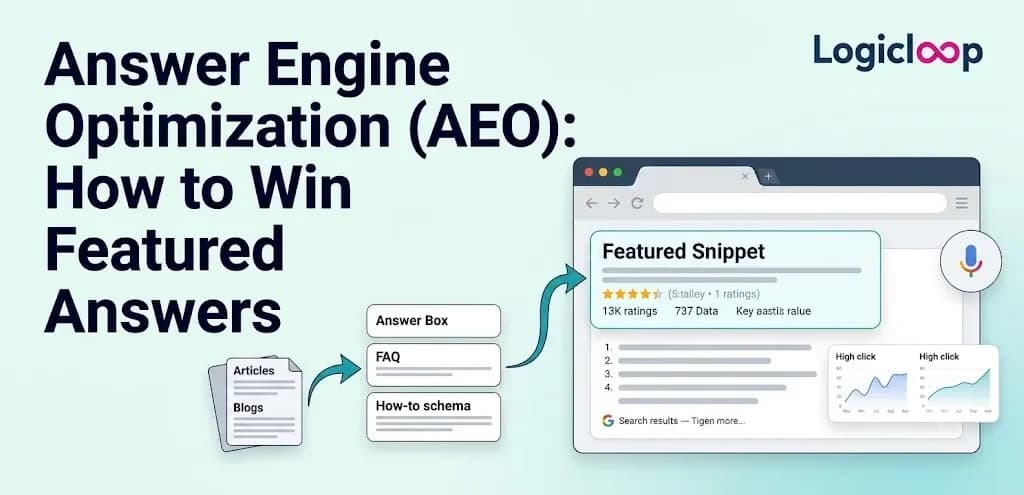
Ask ChatGPT for the best project management software for a five-person marketing team, and here's what you get back: a tidy paragraph naming two or three tools, a sentence on why each one fits, and maybe a link buried at the bottom that almost nobody taps. No ten blue links to scroll. No squinting at which site ranked first. The answer just arrives, already put together.
And if your brand isn't one of those two or three names? You don't exist for that buyer in that moment. That's the reality answer engine optimization was built for, and it's the thing this piece is going to walk you through.
Key Takeaways
- AEO shapes your content so AI systems name and cite your brand inside the answers they generate, not just rank you on a results page.
- Answer engines reward compression and clarity, the opposite of long, keyword-stuffed SEO guides.
- Success is measured by citation frequency and share of voice in AI answers, not rankings alone.
- Technical plumbing (server-side rendering, schema markup) decides whether crawlers even see your content.
- You don't fully control the source, AI pulls from Reddit, G2, and reviews too, so consistency everywhere matters.
What AEO Actually Is
Answer engine optimization is the practice of shaping content so AI systems, ChatGPT, Google's AI Overviews, Perplexity, and Copilot, pull it into the answers they generate and, ideally, credit your brand by name. Think of it as a cousin to traditional SEO (search engine optimization, the decades-old craft of ranking higher on a search engine results page, or SERP). Related family, different target.
SEO chases a position on a results page. AEO chases a mention inside an answer, an answer that might replace the results page altogether. That's a bigger swing than it sounds.
Here's why it matters: zero-click search. That's a search where the person gets what they need without ever clicking through to a website. This behavior isn't new, Google has served weather, sports scores, and unit conversions this way for years. But AI Overviews and chat assistants blew the doors off it. Instead of a snippet answering one narrow question, you now get a synthesized paragraph handling complex, multi-part questions that used to take three or four articles to answer.
You've probably run into the term featured snippet too, that boxed answer Google sometimes floats above the normal results, pulled word-for-word from a page. Featured snippets were the original AEO target, back before "AI" entered the chat. AI Overviews are the same idea, scaled: rather than quoting one page, the model stitches together several.
Why This Shift Is Happening Now, Not Later
A handful of data points explain why agencies and in-house teams suddenly can't stop talking about this.
Research cited by Coursera, drawing on Semrush's 2025 analysis, found that visitors arriving through AI search convert at 4.4 times the rate of visitors from traditional organic search. That's not a rounding error. If AI-referred traffic converts that much better, losing visibility in AI answers stops being a traffic problem and becomes a revenue problem.
Stack the rest of the numbers next to that one:
- McKinsey research from October 2025 found that 44% of people using AI-powered search now treat AI as their primary source of insight when researching something, ahead of a traditional search engine.
- Gartner has projected a 25% drop in conventional search volume by 2026 as research shifts into AI assistants and chat interfaces.
- Data from Authoritas found AI-generated overviews now appear in roughly 30% of tracked searches, a figure that jumps to about 74% for problem-solving queries, the "how do I fix this" and "what's the best way to" questions that used to send people straight into a list of ten websites.
HubSpot piled on with a business angle in January 2026: 42% of buyers evaluating CRM software now use AI search during that evaluation. HubSpot also ran its own AEO push internally and reported an 1,850% increase in qualified leads, with those AEO-sourced leads converting roughly three times better than the norm.
Now, a grain of salt. Will every company see numbers like HubSpot's? Fair to doubt it. HubSpot is a large, established brand sitting on a mountain of existing content. But the direction of the trend is tough to argue with, and that's what should have your attention.
How AEO Differs From the SEO Playbook You Already Know
Spent years optimizing for search engines? Good, a lot of AEO will feel familiar. A chunk of it will also feel backwards.
Traditional SEO rewards comprehensiveness: long guides, internal linking, keywords sprinkled naturally across a page. Answer engines reward compression. A model generating an answer isn't reading your 3,000-word guide top to bottom. It's scanning for the two or three sentences that resolve the question most directly and confidently, then deciding whether to hang your name on them.
The metrics change too. Here's the contrast at a glance.
| Dimension | Traditional SEO | AEO |
|---|---|---|
| Primary target | Position on the SERP | A mention inside the AI answer |
| Content style | Long, comprehensive, keyword-rich | Compressed, direct, question-led |
| Success metric | Rankings, click-through rate | Citation frequency, share of voice |
| What "winning" looks like | Page-one ranking | Named or linked in the answer |
| Traffic model | Clicks to your site | Often zero-click visibility |
You can rank on page one for a keyword and still get zero mentions in the AI Overview sitting right above it, because the model judged that a different source explained the concept more clearly or more concisely. Stings, but it's the game now.
None of this means SEO stops mattering. Google's crawlers and AI crawlers both have to find, render, and index your pages before either can do a thing with them. AEO builds on that foundation, it doesn't replace it.
What Answer Engines Are Actually Looking For
Strip away the acronyms and answer engines want what a good editor wants: a clear, direct response near the top, backed by evidence, written by someone who obviously knows the subject. A few habits make your content much easier to lift and cite.
Lead With the Answer, Not the Setup
Research from Contentstack points out that language models sample heavily from the beginning of a piece of content when deciding what to cite. So burying your actual answer under three paragraphs of throat-clearing is a reliable way to get skipped. Open with a direct, one-to-two-sentence answer, then spend the rest of the section explaining, qualifying, and supporting it.
Structure Around Real Questions, Not Just Topics
A heading that reads "Pricing Considerations" is weaker here than one that reads "How much does answer engine optimization cost?" People ask AI assistants questions in plain language, and content that mirrors that phrasing has an easier time matching what someone typed or said out loud.
Back Claims With Specifics
Vague marketing language doesn't get quoted. Original data, named studies, concrete numbers, and direct quotes all give a model something citable. This is also where E-E-A-T (experience, expertise, authoritativeness, trustworthiness) earns its keep: author bylines, real credentials, and links to primary sources all help an AI system decide your content is trustworthy enough to repeat.
Pro Tip: Before you publish, read your first paragraph on its own and ask, "If a model only saw these three sentences, would it have a citable answer?" If not, rewrite the opening until it does.
A Concrete Example of the Format That Works
Say you sell accounting software and you want to appear when someone asks an AI assistant, "how long does it take to close the books at month end?" A page opening with company history and a product tour won't get picked up. A page that opens like this has a real shot:
"Most small businesses take five to seven business days to close their books each month, though teams using automated reconciliation typically cut that to two or three days. The biggest delays usually come from manually matching bank transactions and chasing down missing receipts."
That's a direct answer, a number, and a reason, all in the first three sentences. Everything after it, a breakdown of where the days go, how automation changes each step, maybe a short case study, supports the claim without making the reader hunt. Compare that to an opening paragraph about "streamlining your financial operations" that never states a single number. It's obvious which one a model can lift with confidence.
The Technical Groundwork Nobody Wants to Do
Content structure gets most of the attention, but AEO has a plumbing problem too.
Many AI crawlers can't execute JavaScript the way a browser does. So if your pricing page or product details only render after a script runs on the visitor's device, some crawlers never see the actual content, just an empty shell. Server-side rendering, where the server sends fully built HTML on the first request, fixes this. If your site leans hard on client-side rendering, run an honest technical audit before you spend weeks rewriting copy a crawler may never read.
Structured data, also called schema markup, is the other technical piece worth nailing. It's a standardized code format, usually JSON-LD, added to a page to explicitly label what the content is: an FAQ, a how-to, a product, an organization. It doesn't change what a visitor sees, but it hands machines an unambiguous description instead of forcing them to guess from formatting. Research from Moburst found that pages carrying schema markup were 36% more likely to appear in AI-generated summaries than pages without it.
Here's how the common types map to AEO work.
| Schema type | Best used for |
|---|---|
| FAQPage | Question-and-answer sections and support pages |
| HowTo | Step-by-step processes and tutorials |
| Article | Blog posts, guides, and editorial content |
| Speakable | Content suited to voice search |
That last one, Speakable, specifically flags content built for voice search, the practice of asking a question out loud through a smart speaker or phone instead of typing it.
You Don't Control Where the Citation Comes From
This is the part that trips up teams used to owning their own website's fate: AI answer engines don't only pull from brand websites. They pull from Reddit threads, G2 and Capterra reviews, Trustpilot ratings, industry publications, and LinkedIn posts, anywhere the model has learned to associate with specific, trustworthy information on a topic.
A glowing but generic review that says "great software, love it" won't move the needle. A detailed review naming exactly which feature solved which problem is the kind of thing that gets pulled into an answer about the best tools for a job.
So AEO isn't purely an on-site content exercise. It touches review management, PR placements, community engagement on forums, and consistency of messaging across every place your brand shows up. If your website says one thing about pricing and a three-year-old forum post says another, don't be shocked when an AI answer repeats the outdated number.
What to Actually Measure
Rankings and organic sessions still matter, but they won't tell you whether AEO is working. You have to track citations directly. Run your target questions through ChatGPT, Perplexity, Gemini, and Google's AI Overviews on a regular schedule, and note three things: whether your brand shows up, how it gets described, and which competitors appear alongside you or instead of you.
Some of this can be semi-automated with rank-tracking tools that have added AI visibility features. A lot of it, honestly, still comes down to a human asking the questions your buyers ask and writing down what comes back.
Also watch referral traffic from AI platforms in your analytics. Right now it's usually a small slice of sessions compared to organic search, but given that 4.4x conversion research from earlier, a small number of highly qualified visitors can outweigh a much larger crowd of browsers who bounce.
Your AEO Audit Checklist
Run through this before you call a page "AEO-ready":
- The first two sentences directly answer the page's core question
- Headings are phrased as real questions people ask
- Claims are backed by numbers, named sources, or original data
- Author byline and credentials are visible (E-E-A-T)
- FAQPage, HowTo, or Article schema is applied correctly
- The page renders full HTML server-side, not just after JavaScript
- Messaging matches what's said on review sites and forums
- Target questions are tracked across ChatGPT, Perplexity, and AI Overviews
Common Mistakes to Avoid
A few patterns sink AEO efforts before they start:
- Slapping FAQ schema on everything overnight. Schema helps, but it can't rescue a page that never actually answers a question.
- Burying the answer. Three paragraphs of setup before the point is a citation killer.
- Ignoring rendering issues. Beautiful copy a crawler can't read is wasted effort.
- Writing for topics instead of questions. "Pricing Considerations" loses to "How much does it cost?"
- Treating it as one-and-done. Publish, then walk away, and you'll never know if citations moved.
Setting a Realistic Timeline
This isn't an overnight fix, and anyone promising instant results is selling something. Research from Moburst suggests some brands see citations appear within weeks of restructuring key pages, while others need two to three months before results show. Data from SearchAtlas puts the broader window at three to six months for measurable results.
That range depends heavily on how much authority your domain already has, how competitive your topic is, and how much content you can rework versus build from scratch.
Where to start? The pages that already rank well in traditional search but read like marketing copy instead of answers. Rewriting an existing, indexed, reasonably authoritative page to lead with a direct answer is faster than building new content from zero, and it gives you a quicker read on whether your changes actually move citations.
Pick ten or fifteen pages tied to your highest-value questions, restructure the openings, add the right schema, fix any rendering issues, then track what happens over the following weeks. Don't assume it worked and sprint off to the next project.
Frequently Asked Questions
What does AEO stand for?
AEO stands for answer engine optimization, the practice of shaping content so AI systems like ChatGPT, Perplexity, Copilot, and Google's AI Overviews pull it into their answers and credit your brand by name.
Is AEO replacing SEO?
No. AEO builds on SEO's foundation rather than replacing it. Both Google's crawlers and AI crawlers still need to find, render, and index your pages before either can use them, so strong SEO fundamentals remain the base layer.
What is zero-click search?
It's a search where the person gets what they need without clicking through to any website. Google has done this for years with weather and sports scores, but AI Overviews and chat assistants have expanded it to complex, multi-part questions.
How do I get my brand cited in AI answers?
Lead with a direct answer in the first sentence or two, structure headings as real questions, back claims with concrete numbers and named sources, add relevant schema markup, and make sure your pages render server-side so crawlers can actually read them.
Does schema markup really help with AEO?
It does. Moburst found that pages with schema markup were 36% more likely to appear in AI-generated summaries than pages without it. FAQPage, HowTo, and Article types come up most in AEO work.
Why does server-side rendering matter for AEO?
Many AI crawlers can't run JavaScript like a browser. If your content only appears after a script executes, those crawlers see an empty shell. Server-side rendering delivers fully built HTML on the first request, so the content is visible.
How long does AEO take to show results?
Moburst suggests citations can appear within weeks for some brands, or two to three months for others. SearchAtlas puts the broader window at three to six months, depending on your domain authority, topic competitiveness, and how much content you rework.
Can AI answers pull from sites other than my own?
Yes, and this catches many teams off guard. AI engines pull from Reddit, G2, Capterra, Trustpilot, LinkedIn, and industry publications too. Detailed, specific reviews and consistent messaging across those platforms all feed into what the model repeats.
How do I measure whether AEO is working?
Track citations directly by running your buyers' questions through ChatGPT, Perplexity, Gemini, and AI Overviews on a schedule, noting whether and how your brand appears. Also monitor AI referral traffic in your analytics, since those visitors tend to convert well.
Where should I start with AEO?
Start with pages that already rank in traditional search but read like marketing copy. Restructure the openings to lead with a direct answer, add the right schema, fix rendering issues, and track the results over the following weeks before moving on.
Final Thoughts
The brands that show up in AI answers a year from now won't be the ones that panicked and slapped FAQ schema on every page overnight. They'll be the ones that treated this the way they should have treated their best content all along: written to actually answer the question, backed by real evidence, and structured so a reader, human or machine, never has to dig for the point.
That's the whole game. AEO looks new because the acronyms are new, but underneath it rewards the same thing good writing always has, clarity, honesty, and a willingness to say the useful thing first. Get that right, and the citations tend to follow.